

LinkedIn Prospecting Software for B2B Companies Entering the U.S. Market
Published · Giress Kenn
Practical guidance for founders, B2B teams, and small agencies turning buyer signals into reviewed next actions.
Photo by Sean Pollock on Unsplash
Entering the U.S. market requires more than changing a location filter. A prospect may match your overseas customer profile while needing a different integration, support schedule, contracting process, or implementation model. Use prospecting software to test a defined U.S. segment against what your company can deliver. Keep market learning and active sales opportunities distinct.
Quick Answer
For U.S. market entry, choose LinkedIn prospecting software that supports a reviewed audience, original evidence, and controlled outreach. Privly can help evaluate relevant prospects against your business context. Verify U.S. delivery requirements before scaling, and treat responses as evidence about a specific segment rather than proof that the entire market is ready.
Which U.S. segment can you serve now?
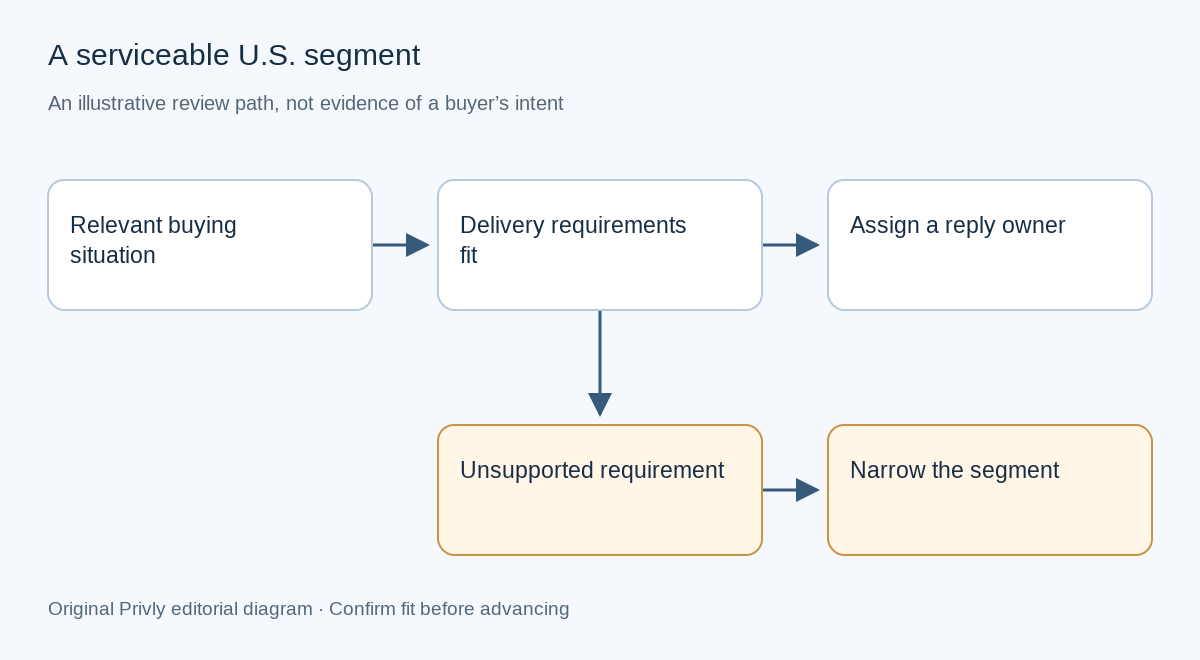
Choose a customer situation your team can support today. Define the industry, company type, relevant role, and delivery prerequisites. Nationwide coverage does not require a campaign aimed at every U.S. business.
Review the business profile setup rather than carrying an overseas brief into a new market unchanged. A product that relies on a regional payment provider or a particular accounting integration may need narrower eligibility.
The free ICP tool can expose how your public positioning reads. Correct assumptions about geography and the offer before using the profile for prospecting.
Separate a relevant problem from a deliverable opportunity
Public evidence can show that a person is discussing a problem. It cannot establish that your company can satisfy every U.S. buying requirement.
Use buyer-intent monitoring to evaluate context and the opportunity review guide to inspect the original conversation. Keep unresolved requirements visible in the qualification record.
For a hypothetical European workflow vendor entering the U.S., a prospect’s reporting problem may fit the product. The vendor still needs to clarify the required systems, implementation ownership, and support expectations before proposing a rollout.
This is an illustrative evaluation, not a claim that U.S. buyers share one procurement process or that Privly verifies legal or technical eligibility automatically.
What should change in the first message?
Use the buyer’s language for the problem and describe the actual offer. Avoid implying a U.S. office, local team, customer reference, or certification that you do not have.
A concise question about the observed workflow is more useful than a generic announcement that your company is expanding. If a relevant customer example exists, preserve its geography, scope, and measurement period rather than presenting it as U.S. proof.
The qualification overview is useful for separating fit from timing. A location match alone does not establish urgency or budget.
Who will handle U.S. conversations?
Name the owner before activating outreach. A prospect should not receive a timely first message followed by a long silence because the team has no coverage for the next step.
Use the campaign guide to inspect sender, timing, message previews, and execution mode. Confirm the displayed schedule rather than assuming it follows the prospect’s local timezone.
Then test the messages workflow with the actual operator. When a technical or commercial question needs another teammate, preserve the buyer’s context and identify who responds.
If U.S. sales records must enter an existing CRM, validate the integration scope. Do not assume territory assignment, currency handling, or complete history synchronization from a general integration label.
Keep platform rules and legal requirements separate
LinkedIn’s automated activity guidance addresses platform use. A vendor subscription does not override those rules.
For commercial email to U.S. recipients, review the FTC’s CAN-SPAM guidance, including accurate sender information, a valid postal address, and opt-out handling. B2B email is not categorically exempt.
Your location, recipient location, data processing, and other facts may introduce additional requirements. U.S. targeting alone does not establish that only U.S. rules apply. Resolve the actual cross-border requirements with appropriate advice rather than relying on a prospecting tool as a compliance determination.
What evidence supports expanding the program?
Look for recurring fit among the specific accounts reviewed, clear reasons for rejection, and conversations that your team can advance. A few positive replies do not establish nationwide demand.
Compare the software plan with operator time, implementation effort, and any additional systems needed. Keep the experiment’s cost separate from the full market-entry budget.
If prospects repeatedly require something unavailable, change the segment or delivery offer before increasing activity. If the problem is slow follow-through, address ownership rather than buying more discovery capacity.
U.S. market-entry readiness record
Use this record for one offer and one audience. The examples are illustrative; they do not describe a Privly customer or guarantee an outcome.
| Review area | Record the observation | Resolve before advancing |
|---|---|---|
| Segment | A specific industry, company size, and region | Can the product support this segment? |
| Delivery | Required integrations and service boundaries | What procurement requirements remain unknown? |
| Conversation | A named reply owner and available hours | Can that person handle the buyer’s time zone? |
| Expansion | Observed reasons for progress and rejection | Do results transfer beyond the tested segment? |
FAQ
Can a location filter validate a U.S. market?
No. It can help define an audience, but market validation requires evidence about requirements, willingness to buy, and your ability to deliver.
Must we have a U.S. office before prospecting?
That depends on the business and buyer requirements. Represent your actual location and support model accurately, and investigate any applicable obligations.
Can we reuse overseas case studies?
Use only substantiated examples you are permitted to share, with their original context. Do not relabel them as U.S. results.
What should the initial evaluation focus on?
One deliverable offer, one U.S. segment, a clear conversation owner, and a process for recording unmet requirements.
Test a specific U.S. buying situation
Build a reviewed profile in Privly and evaluate prospects against your actual U.S. delivery readiness before expanding.
Sources and further reading
The linked product guides describe the workflow; confirm current availability and terms before choosing a plan. Examples and worksheets are illustrative, not customer results.
LinkedIn’s automated activity policy restricts automated activity. Vendor settings do not grant platform permission.
 Bootstrapped Startups
LinkedIn Lead Generation Software for Bootstrapped Startups
Choose LinkedIn prospecting software around runway, founder time, qualified conversations, and the cost of a realistic first campaign.
November 25, 2026 · Giress Kenn Marketing Agencies
LinkedIn Client Acquisition Software for B2B Marketing Agencies
Choose LinkedIn acquisition software for your agency’s own pipeline by offer fit, buying evidence, sales ownership, and proposal quality.
November 25, 2026 · Giress Kenn Appointment Setting
LinkedIn Outreach Software for Appointment-Setting Agencies
Evaluate appointment-setting software by meeting definitions, client evidence, sender access, reply handling, and sales handoff quality.
November 25, 2026 · Giress Kenn