

LinkedIn Lead Generation Software for Bootstrapped Startups
Published · Giress Kenn
Practical guidance for founders, B2B teams, and small agencies turning buyer signals into reviewed next actions.
A bootstrapped startup should buy prospecting software when it can turn the output into useful sales conversations. A large lead allowance is not a reason to commit cash if the founder has no time to review prospects or answer replies. Privly is worth evaluating when your bottleneck is finding relevant public buying context and moving it into reviewed outreach. Start with a narrow commercial question: can this workflow help you reach people who fit the product you can deliver today?
Quick Answer
Choose LinkedIn lead generation software for a bootstrapped startup by comparing usable prospect quality, founder workload, and cash commitment. Privly offers website-based setup, evidence review, and campaign workflows. Test one offer with a small reviewed audience before paying for capacity you cannot operate or treating generated leads as evidence of product-market fit.
What should you buy before you have repeatable sales?
Buy support for a task you can name. If you already know the audience but cannot prepare consistent follow-up, campaign operation may be the priority. If you cannot explain why any particular person would need the product, more sending capacity comes too early.
The founder use case describes starting from a specific customer situation. That is a useful evaluation boundary for a startup with several possible segments. Keep the first test narrow enough that a rejection can teach you something.
A founder selling onboarding software to agencies should not combine that audience with enterprise HR teams merely because both perform onboarding. Their requirements, buying processes, and implementation constraints may differ. The software should help maintain a coherent brief, not conceal that uncertainty behind a larger list.
How can you test targeting without committing to a full rollout?
Use Privly’s free ICP identifier to review what your website communicates. Correct the proposed audience and offer before drawing conclusions from the resulting prospects.
Then follow the business profile setup guide. Include required compatibility, delivery boundaries, and exclusions. If the product supports only one CRM, that requirement belongs in the evaluation rather than in an apology after a prospect books a call.
For each match, inspect the original context through the opportunity review workflow. Keep fit and active need separate. A person can match your intended customer description without currently evaluating a solution.
How should you compare subscription cost with runway?
Separate the advertised monthly equivalent from the amount charged. Review Privly’s current pricing and the selected checkout terms for the price, billing period, and total due. Annual billing creates an upfront cash commitment even when a page presents a monthly equivalent.
Compare the available preview and trial options and confirm their current limits before starting. A discovery preview does not establish that you have tested the sending workflow.
Build a budget that includes the subscription, any required additional capacity, and operator time. For a hypothetical founder valuing five hours of weekly sales work at $50 per hour, four weeks represent $1,000 of planning cost. That assumption is not a market wage or a promised saving. Its purpose is to show why founder attention belongs in the calculation.
Do not compare that cost with projected revenue from an assumed conversion rate. Use actual observed conversations and sales outcomes when you have them.
What should a useful first campaign teach you?
It should reveal whether the people fit, whether the problem is relevant, and whether the next step is appropriate. Privly’s qualification overview helps frame those as separate review questions.
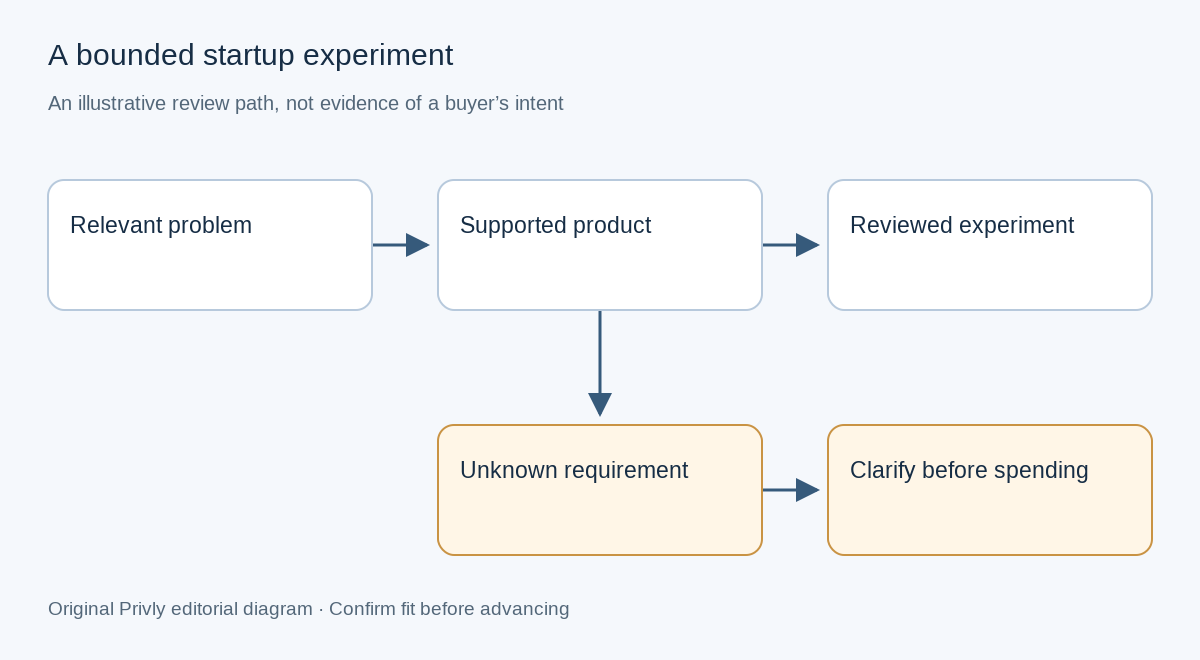
Suppose a fictional U.S. startup sells approval software for small distributors. A prospect describes purchase requests getting stuck. The founder verifies the context and asks where the delay occurs. The founder does not claim the company has budget or wants to replace its system.
A response explaining an unsupported requirement is still useful learning. Record that reason rather than counting the response as a qualified opportunity. A polite compliment is not equivalent to an agreed product evaluation.
Use the campaign guide to review the audience, message, sender, and execution mode. Keep the founder available to answer the questions the campaign creates.
When should you expand, change direction, or stop?
Expand when you can repeatedly identify relevant prospects and handle the resulting conversations within the time available. Change the brief when mismatches point to a specific audience or compatibility problem. Stop the experiment if the offer cannot yet satisfy the requirements you are uncovering.
The leads and messages workflow supports reviewing the conversation, but your learning record should explain why the prospect moved forward or declined. Do not mistake a fuller inbox for validated demand.
If the startup cannot operate outreach, compare staffing or service options separately. Privly’s terms describe customer-operated software; the subscription does not supply a salesperson.
Also review LinkedIn’s automation policy. Vendor controls do not guarantee account safety or platform permission.
Startup campaign decision sheet
Use this record for one offer and one audience. The examples are illustrative; they do not describe a Privly customer or guarantee an outcome.
| Review area | Record the observation | Resolve before advancing |
|---|---|---|
| Offer | One product, audience, and supported integration | Can this product solve the described problem today? |
| Cash | Checkout total and billing period | Can runway absorb the upfront commitment? |
| Time | Named founder and weekly review hours | Can replies receive useful follow-up? |
| Outcome | Reasons for fit, rejection, and agreed next steps | Does observed demand justify another experiment? |
FAQ
Is the lowest-priced plan always the right starting point?
No. It must support the workflow you need to test. Compare access, sender capacity, and evaluation limits before focusing on headline price.
Should we buy annually to reduce the monthly equivalent?
Only after considering upfront cash and confidence in continued use. A lower monthly equivalent does not remove the annual commitment.
Can prospecting results prove product-market fit?
Not by themselves. Examine buyer requirements, willingness to proceed, actual purchases, and the ability to deliver successfully.
What is the strongest reason to delay purchase?
You cannot yet explain the offer or assign someone to review prospects and handle replies. Resolve that operating gap first.
Evaluate one offer before adding capacity
Review Privly’s plans and trial options, then test a focused audience against the product and founder time you actually have.
Sources and further reading
The linked product guides describe the workflow; confirm current availability and terms before choosing a plan. Examples and worksheets are illustrative, not customer results.
LinkedIn’s automated activity policy restricts automated activity. Vendor settings do not grant platform permission.
 Marketing Agencies
LinkedIn Client Acquisition Software for B2B Marketing Agencies
Choose LinkedIn acquisition software for your agency’s own pipeline by offer fit, buying evidence, sales ownership, and proposal quality.
November 25, 2026 · Giress Kenn Appointment Setting
LinkedIn Outreach Software for Appointment-Setting Agencies
Evaluate appointment-setting software by meeting definitions, client evidence, sender access, reply handling, and sales handoff quality.
November 25, 2026 · Giress Kenn U.S. Market Entry
LinkedIn Prospecting Software for B2B Companies Entering the U.S. Market
Evaluate LinkedIn prospecting software for U.S. expansion by customer fit, local delivery readiness, evidence, messaging, and sales ownership.
November 25, 2026 · Giress Kenn