

LinkedIn Client Acquisition Software for B2B Marketing Agencies
Published · Giress Kenn
Practical guidance for founders, B2B teams, and small agencies turning buyer signals into reviewed next actions.
Photo by Vitaly Gariev on Unsplash
Winning clients for your agency is a different workflow from operating campaigns for those clients. The audience, sender, evidence, and success measures should reflect your own service business. Choose software that helps you identify a suitable company with a relevant problem and prepare an accurate approach. A prospecting platform cannot make an undifferentiated service menu into a compelling reason to talk.
Quick Answer
B2B marketing agencies should evaluate LinkedIn client acquisition software around their own offer, client fit, and sales follow-through. Privly can connect relevant public evidence with reviewed outreach. Keep agency acquisition separate from client delivery, and judge the workflow by suitable conversations and proposals rather than the number of prospects collected.
Separate your agency’s pipeline from client delivery
Use a clear business context for your own acquisition work. A campaign selling your paid media service should not inherit a client’s audience definition or send from the wrong account.
Privly’s agency use case focuses on keeping client context coherent. Apply the same discipline to your agency’s own workspace and approved offer.
The workspace separation guide is useful when the same operators work on both acquisition and delivery. Confirm the active business, audience, and sender before launch. Do not assume workspace capacity and connected-sender capacity are interchangeable.
Choose the service before searching for buyers
A broad claim that you “help B2B companies grow” leaves too many questions unanswered. Identify the work you deliver and the client conditions required for it to succeed.
For a paid media engagement, those questions might involve the offer, available creative, conversion tracking, and sales follow-up. For an SEO engagement, they might involve publishing access and the ability to implement recommendations. These are example qualification questions, not assumed product fields.
Review your business profile around one service. Include exclusions for companies you cannot serve well. An agency that needs a minimum implementation commitment should establish that before writing a detailed proposal.
What evidence suggests a useful acquisition conversation?
Look for context tied to the service you offer. A marketing leader discussing reporting gaps may be relevant to an analytics engagement. A general post celebrating growth is not automatically evidence of dissatisfaction with the current agency.
Use buyer-intent monitoring to evaluate available context and the opportunity review workflow to check its meaning.
Keep the buyer’s expressed problem separate from your diagnosis. A drop in conversions can have many causes. Do not claim to have identified the cause from a short LinkedIn post, and do not imply access to private account performance.
The qualification framework helps keep company fit and evidence of need as separate decisions.
Turn the evidence into a bounded first offer
Offer a next step that matches what you know. A discussion of measurement requirements is more defensible than a promise to reduce acquisition cost before reviewing the account.
A hypothetical U.S. agency specializing in B2B conversion tracking sees a founder describe disagreements between advertising and CRM reports. The agency asks which event the teams use to define a qualified conversion. If the founder wants help, the agency can discuss a scoped review of that reporting boundary.
This is an illustrative workflow, not a customer result. It assumes neither a specific improvement nor a willingness to change agencies.
Review the audience, claims, and sequence in the campaign guide. Use only case studies you are authorized to share, with the original scope and measurement period preserved.
Keep the sales conversation connected to delivery
An agency salesperson should not promise an audit, integration, or implementation that the delivery team cannot provide. Before a proposal, confirm the required access, client responsibilities, and actual work included.
Use the leads and messages workflow to preserve the buyer’s question and next commitment. Keep proposal details and delivery assumptions in the agency’s agreed sales record.
If a prospect becomes a client, decide how its delivery workspace will be established. Do not assume a sales record automatically becomes a configured client environment. That transition is a separate implementation task.
Compare software cost with the acquisition work retained
Review Privly’s pricing against the accounts and operators needed for your own pipeline. An agency plan may be relevant to multi-client delivery, but the word “agency” in your business name does not by itself determine the right plan for acquisition.
Include research review, sales calls, proposal preparation, and follow-up in your cost model. A prospecting subscription does not remove those responsibilities. Privly’s service terms identify the product as customer-operated software.
Measure suitable conversations, proposals accepted for consideration, and actual customers separately. A prospect asking for your deck is not the same as a qualified opportunity.
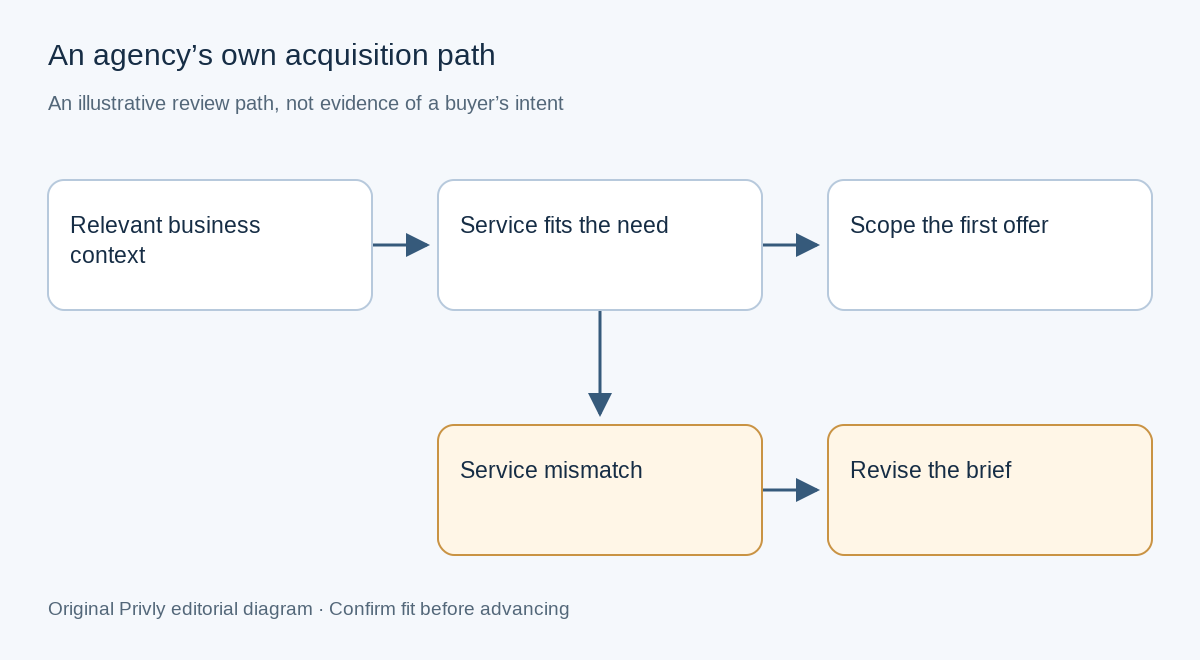
Agency acquisition brief
Use this record for one offer and one audience. The examples are illustrative; they do not describe a Privly customer or guarantee an outcome.
| Review area | Record the observation | Resolve before advancing |
|---|---|---|
| Service | An analytics review for a defined type of B2B team | Is this the service the buyer needs? |
| Context | A public discussion about reporting gaps | Which decisions does the gap affect? |
| Ownership | Your agency workspace and named sender | Who handles the reply and proposal? |
| Delivery | A bounded review with defined inputs | Can the delivery team fulfil the offer? |
FAQ
Is agency acquisition the same as client campaign delivery?
No. Your agency’s offer and pipeline should remain distinct from the campaigns you operate on behalf of clients.
Should we promote every service in one sequence?
Only if the audience and buying problem genuinely align. A focused service makes qualification and message review easier.
Can we claim likely performance improvements in the first message?
Use substantiated evidence with its actual context. Do not project another client’s result onto a prospect whose situation you have not reviewed.
What should an agency evaluate in a trial?
Whether the workflow produces relevant evidence, supports accurate outreach, and lets the sales owner move a suitable conversation toward a scoped proposal.
Evaluate your own acquisition offer first
Review Privly’s customer-profile workflow with your agency’s service and exclusions, then test a small acquisition campaign.
Sources and further reading
The linked product guides describe the workflow; confirm current availability and terms before choosing a plan. Examples and worksheets are illustrative, not customer results.
LinkedIn’s automated activity policy restricts automated activity. Vendor settings do not grant platform permission.
 Bootstrapped Startups
LinkedIn Lead Generation Software for Bootstrapped Startups
Choose LinkedIn prospecting software around runway, founder time, qualified conversations, and the cost of a realistic first campaign.
November 25, 2026 · Giress Kenn Appointment Setting
LinkedIn Outreach Software for Appointment-Setting Agencies
Evaluate appointment-setting software by meeting definitions, client evidence, sender access, reply handling, and sales handoff quality.
November 25, 2026 · Giress Kenn U.S. Market Entry
LinkedIn Prospecting Software for B2B Companies Entering the U.S. Market
Evaluate LinkedIn prospecting software for U.S. expansion by customer fit, local delivery readiness, evidence, messaging, and sales ownership.
November 25, 2026 · Giress Kenn