

LinkedIn Outreach Software for Appointment-Setting Agencies
Published · Giress Kenn
Practical guidance for founders, B2B teams, and small agencies turning buyer signals into reviewed next actions.
Photo by Vitaly Gariev on Unsplash
An appointment-setting agency sells a defined service. Its prospecting software is one part of delivering that service. Before comparing platforms, agree what counts as an acceptable appointment and who verifies it. A calendar booking alone cannot establish account fit, attendance, or a useful sales conversation. The software evaluation should follow the prospect through qualification, outreach, reply handling, and client acceptance.
Quick Answer
Appointment-setting agencies should compare LinkedIn outreach software by client separation, qualification evidence, message review, and meeting handoffs. Privly supports customer-operated prospecting and campaign workflows. Define booked, held, and client-accepted meetings separately, and verify the integration and reporting details required by your service agreement before committing to a platform.
Define the meeting before defining the campaign
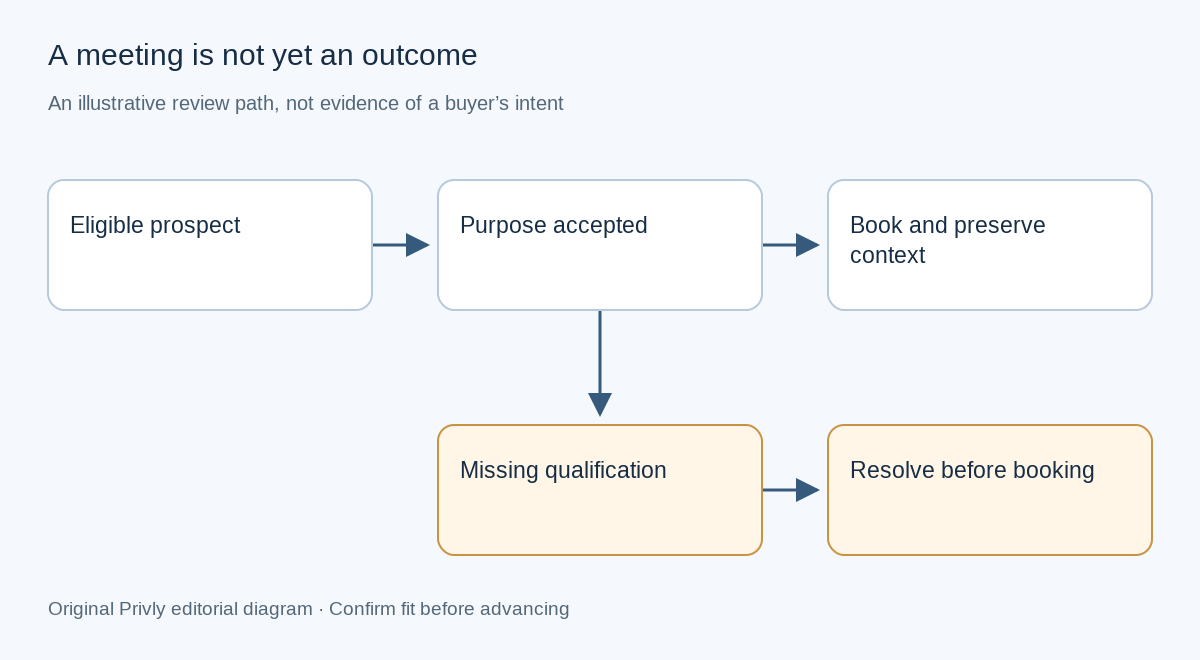
Write down the required company characteristics, relevant role, buyer problem, and agreed next step. Then distinguish a booked appointment from one that occurred and one the client accepted as suitable.
This is a service definition, not a set of statuses you should assume the software provides. The software-versus-appointment-setting guide explains why execution responsibilities belong in the comparison.
Avoid guaranteeing that a prospecting subscription will produce a specific number of appointments. The agency’s offer, audience, message quality, operating effort, and the buyer’s decisions all affect the outcome.
Keep each client’s eligibility rules intact
One client may serve only U.S. companies with an internal technical team. Another may sell to smaller businesses that outsource delivery. Combining their qualification rules would create inappropriate meetings for at least one of them.
Use the business profile guide to review each client’s actual offer. The client workspace guide is relevant when several operators share responsibility.
Check the sender and authorized account as well as the audience. A correct message sent on behalf of the wrong client is still an operational failure.
Preserve the reason the prospect agreed to talk
Inspect the original source through Privly’s opportunity review. If the prospect later replies, keep the actual question and commitment connected to the handoff.
The qualification overview helps separate fit from a relevant signal. Neither alone establishes the client’s appointment criteria.
A buyer agreeing to receive information has not necessarily agreed to a sales call. Clarify the intended next step before describing the outcome to the client.
What should happen between a reply and a booked call?
An operator should answer the buyer’s question, confirm the purpose of the call, and identify the appropriate client participant. Record unresolved requirements rather than hiding them to make the appointment appear stronger.
Use the messages workflow to review the conversation. Ask the client how it wants to receive the context and who accepts responsibility for the next action.
A hypothetical agency serving a U.S. IT provider receives a reply asking whether weekend coverage is available. The operator checks with the client before booking a discussion around that requirement. If the service cannot meet it, the operator should not present the meeting as qualified.
This example illustrates service discipline; it does not claim that Privly automatically validates service coverage or books appointments.
Which automation behaviors should you demonstrate?
Inspect audience review, message previews, execution mode, and the effect of a reply on later sequence steps. The campaign guide documents these operating choices.
Confirm how your team handles absences and stop requests. An automated sequence is not a substitute for an operator who understands the buyer’s response.
LinkedIn’s automation policy is separate from vendor controls. Do not sell “account-safe automation” merely because the tool provides sending limits.
If email is part of the service, the FTC’s CAN-SPAM guide explains that B2B commercial email is covered and that responsibility cannot simply be contracted away. Review the applicable requirements for the actual campaign.
How should agencies budget for delivery?
Compare current plan capacity with client workspaces, senders, and operators. Then add the labor needed for research review, conversations, appointment coordination, and client reporting.
Under Privly’s terms, your team operates the software. It does not include Privly staff performing the appointment-setting service.
Where a CRM handoff is required, inspect the integration guide and verify actual fields and events. Do not assume a contact export includes complete conversation history or attendance outcomes.
Meeting acceptance checklist
Use this record for one offer and one audience. The examples are illustrative; they do not describe a Privly customer or guarantee an outcome.
| Review area | Record the observation | Resolve before advancing |
|---|---|---|
| Eligible account | The employer meets the client’s agreed criteria | Which exclusions still need checking? |
| Booked | A time has been agreed | Has the prospect accepted the purpose? |
| Held | The conversation actually took place | Were the required participants present? |
| Client accepted | The client confirms the agreed qualification standard | Why was an unsuitable meeting rejected? |
FAQ
Does a booked call count as a qualified meeting?
Only if it meets the definition agreed with the client. Keep booked, held, and accepted outcomes separate.
Can the platform replace appointment-setting staff?
It can support documented tasks, but someone must own qualification, responses, scheduling coordination, and the client relationship.
Should clients approve every message?
Agree an approval process appropriate to the engagement, and verify how it will be recorded. Do not assume a particular client sign-off feature exists.
What is a useful pilot?
Trace a reviewed prospect through a reply and client handoff. Verify the evidence and responsibilities at each transition before increasing activity.
Evaluate delivery with one client
Explore Privly’s agency workflow and compare it against your appointment definition and handoff agreement.
Sources and further reading
The linked product guides describe the workflow; confirm current availability and terms before choosing a plan. Examples and worksheets are illustrative, not customer results.
LinkedIn’s automated activity policy restricts automated activity. Vendor settings do not grant platform permission.
 Bootstrapped Startups
LinkedIn Lead Generation Software for Bootstrapped Startups
Choose LinkedIn prospecting software around runway, founder time, qualified conversations, and the cost of a realistic first campaign.
November 25, 2026 · Giress Kenn Marketing Agencies
LinkedIn Client Acquisition Software for B2B Marketing Agencies
Choose LinkedIn acquisition software for your agency’s own pipeline by offer fit, buying evidence, sales ownership, and proposal quality.
November 25, 2026 · Giress Kenn U.S. Market Entry
LinkedIn Prospecting Software for B2B Companies Entering the U.S. Market
Evaluate LinkedIn prospecting software for U.S. expansion by customer fit, local delivery readiness, evidence, messaging, and sales ownership.
November 25, 2026 · Giress Kenn