

LinkedIn Outreach Software for Small Remote Sales Teams
Published · Giress Kenn
Practical guidance for founders, B2B teams, and small agencies turning buyer signals into reviewed next actions.
Photo by Rodrigo Rodrigues | WOLF Λ R T on Unsplash
A buyer replies while the salesperson is offline. The founder can see a notification, operations has a list of leads, and nobody knows who promised to send the example. For a small remote sales team, LinkedIn outreach software needs to preserve context and responsibility across working hours. This guide shows how to evaluate that continuity before adding more campaigns or connected accounts.
Start with the people who need to operate the workflow
Count three things separately: people who need workspace access, connected LinkedIn senders, and people authorized to act on a conversation. A founder reviewing targeting, a salesperson sending messages, and an operations teammate checking records may need different permissions.
Write down each person’s job before comparing subscription allowances. Access to a workspace does not automatically mean access to every conversation or permission to use another member’s sender. Demonstrate the actual tasks from each intended role, rather than performing the whole evaluation as the account owner.
| Person | Primary task | Access to demonstrate |
|---|---|---|
| Founder | Review the offer and resolve exceptions | Read the relevant evidence and make the agreed decisions |
| Salesperson | Review outreach and continue buyer conversations | Use the intended sender and access the conversation |
| Operations teammate | Maintain records and prepare handoffs | Find context and update the permitted records |
| Named backup | Cover a planned absence if authorized | Perform the exact permitted response or escalation |
Use the per-seat versus per-sender guide to compare capacity, and the workspace-access documentation to check authority. These are separate purchasing questions.
Keep the next action understandable without a meeting
A useful conversation record explains why the person was selected, what was sent, what the buyer said, and what happens next. Include the supporting link and any commitment already made. “Good lead—follow up” leaves the next person to reconstruct the work.
Keep the operational record in an agreed place. A chat notification can point to it, but the notification should not be the only copy of a decision. When a call or internal discussion changes the next step, write the conclusion back into the record.
GitLab’s communication handbook describes asynchronous communication as its starting point and emphasizes recording conclusions from offline conversations. Apply that principle to sales handoffs: provide enough context for the recipient to act when they become available.
Separate campaign scheduling from reply coverage
Campaign timing determines when eligible activity can run. Reply coverage determines who reads and responds afterward. Setting working hours does not create staff availability, assign a backup, or establish a response promise to a buyer.
Write the campaign timezone and the team’s coverage windows explicitly. Use named timezones when recording a commitment so a colleague does not have to guess what “tomorrow afternoon” means. Review actual scheduled dates when changing timing or working across daylight-saving changes.
For a fictional team with people in Boston, Austin, and Portland, the latest working day may extend beyond the first sender’s availability. That can be useful for preparation and coordination, but the team must still decide who is authorized to communicate and when the buyer should expect an answer.
The scheduled campaign guide explains the product timing to inspect. Use the campaign setup documentation for the selected sender, execution mode, and review. Confirm recipient-local scheduling or holiday behavior separately if those are requirements.
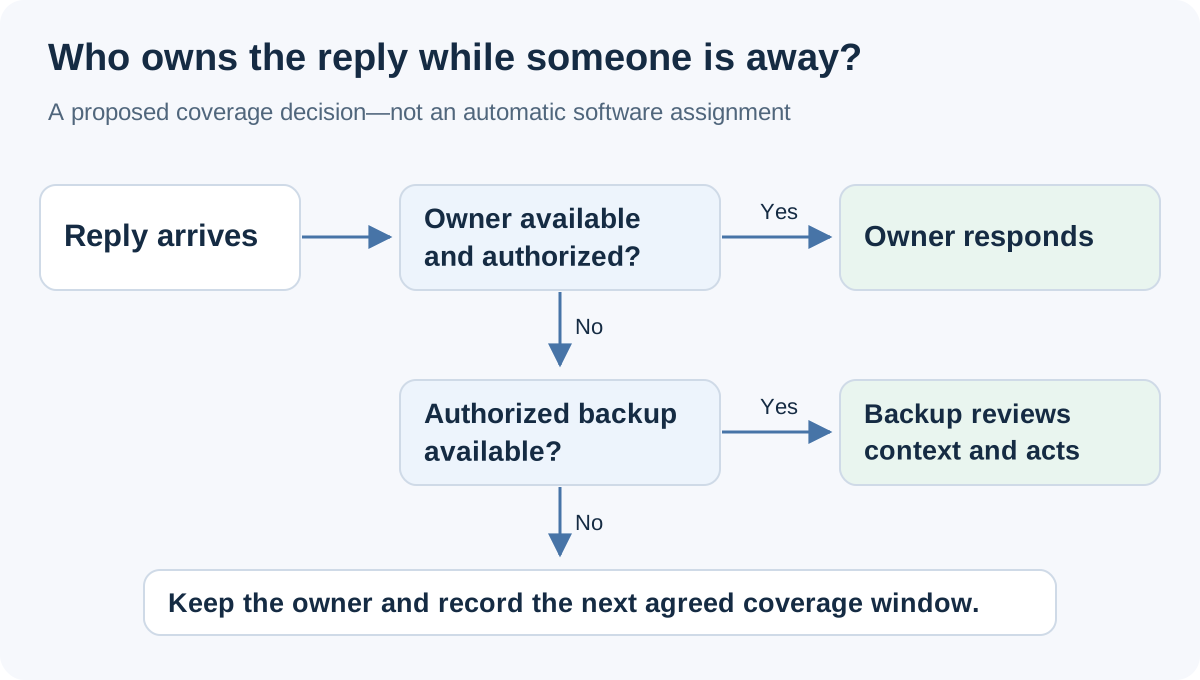
Agree what happens when the owner is offline
Choose a response policy your team can maintain. Some teams arrange an authorized backup. Others let the owner respond during the next published working window. Either can be coherent when the buyer’s commitments and the team’s availability are clear.
A backup needs both context and authority. Being copied into an internal discussion is not permission to operate another person’s account. If the backup can only prepare material or notify the owner, record that limit and keep the response with the authorized person.
| Situation | Agreed action |
|---|---|
| Owner is available | Owner reads the conversation and records the next step |
| Owner is away; an authorized backup is available | Backup checks prior promises and records who is acting |
| Backup can review but cannot send | Backup prepares context and escalates to the authorized owner |
| Nobody can cover the next working window | Record when review resumes and consider pausing new activity |
| Buyer declines or asks to stop | Respect the response and prevent further unwanted follow-up |
Stop the sequence from becoming a second conversation
After a buyer replies, the next action should reflect that answer. Review any pending follow-ups and stop conditions so the buyer does not receive a generic nudge while someone on the team is preparing a specific response.
During an owner change, check the sender and pending actions as well as the lead assignment. Changing the person responsible for a record does not by itself explain what should happen to a scheduled message. Record that decision explicitly.
The stop-on-reply guide explains the behavior to evaluate. Use leads and messages to inspect the actual conversation before continuing it. A pause concerns future activity; it cannot recall a message already delivered.
Worked example: a planned absence
Dana, the salesperson in a fictional software team, will be away on Friday. On Thursday, Dana reviews open conversations, records the promises already made, and tells the founder which cases may need a decision. Lee in operations prepares the supporting material but does not acquire sending authority simply by covering the checklist.
The team identifies one buyer who expects an answer on Friday. An authorized colleague accepts that conversation with the relevant history, or Dana agrees an alternative timing with the buyer before leaving. Conversations without a time-sensitive commitment remain assigned for the next working window.
Before starting additional activity during the absence, the team decides whether it has capacity to handle replies. It can reduce or pause new outreach while preserving the agreed plan for existing conversations. That is a staffing decision, not an assumption that campaign software schedules human coverage.
Test the handoff, the absence, and the failure
Run a small evaluation with one reviewed audience and the actual intended operators. Have one person review a prospect, another inspect the message and source, and the conversation owner explain the next action. The goal is to see whether context survives the handoff without a live explanation.
Then rehearse an absence and a blocked connection. Confirm who receives the issue, who can resolve it, and what happens to pending work. Do not broaden someone’s access just to get through a demonstration; establish the permissions the real operating model requires.
- Each person can perform their assigned task with their own workspace access.
- The selected sender and campaign timezone are visible and understood.
- A reply has one accountable owner, an actual next action, and any promised deadline.
- An absence has an agreed backup or next coverage window.
- Connection failures and campaign pauses have a named recovery owner.
LinkedIn’s User Agreement and automated-activity policy remain relevant when evaluating an outreach tool. Do not share login credentials to improvise coverage, or treat vendor scheduling controls as LinkedIn approval.
Compare operating cost and coordination effort
Include the subscription, required member and sender capacity, and the recurring work to review evidence, prepare messages, and handle replies. Measure the specific coordination problem you want to solve before assuming a tool saves time.
For example, a fictional team spending 20 minutes each working day reconstructing conversation context spends 100 minutes over five working days. Use the same definition during a pilot and compare the observed effort. This is a planning calculation, not an expected saving or an outreach-performance benchmark.
Also inspect unresolved work: conversations with no owner, overdue commitments, and replies waiting outside the agreed window. A shared inbox is helpful only if the team can determine what to do next.
Questions remote sales teams ask
Does every teammate need a connected LinkedIn account?
No. Separate people who review or administer from people who need to send, then compare both the plan allowances and the actual permissions required.
Can a backup automatically answer another sender’s conversations?
Do not assume that. Demonstrate the permitted action for the relevant connected account and role before making it part of your coverage agreement.
Does working-hour scheduling provide continuous coverage?
No. It governs campaign timing. Human availability, backup responsibilities, and response commitments require a separate team agreement.
Choose a workflow the whole team can operate
Compare Privly’s plans with your actual operators and connected senders. Evaluate one complete prospect, reply, and absence handoff before adding capacity.
Source note: reviewed November 19, 2026. GitLab provides the asynchronous communication example; LinkedIn provides the platform rules. Privly’s linked documentation covers product operation. The coverage agreement, fictional team, handoff notes, and time calculation are original examples.
 Agency Reporting
LinkedIn Lead Generation Software With Client Reporting
Compare LinkedIn client reporting software using a practical metrics worksheet, permission checks, attribution rules, and an agency reporting example.
November 19, 2026 · Giress Kenn Ideal Customer Profile
LinkedIn Prospecting Software That Starts With Your Company Website
Turn your company website into a reviewed LinkedIn prospecting brief. Use a profile worksheet, exclusions, and sample-lead review before launching outreach.
November 19, 2026 · Giress Kenn Buyer Intent
LinkedIn Intent Monitoring Tools: Compare Scan Frequency and Signal Freshness
Compare LinkedIn intent monitoring with four timestamps, a freshness worksheet, and a worked example. Separate scan cadence from useful buying evidence.
November 19, 2026 · Giress Kenn