

LinkedIn Intent Monitoring Tools: Compare Scan Frequency and Signal Freshness
Published · Giress Kenn
Practical guidance for founders, B2B teams, and small agencies turning buyer signals into reviewed next actions.
A post can be new while the problem it describes is already solved. A monitoring tool can scan often while your team leaves its results unread. When comparing LinkedIn intent monitoring tools, measure the age and usefulness of the evidence as well as the collection schedule. This guide gives you a practical way to evaluate both.
Signal freshness is more than how often a tool scans
Scan frequency describes a collection schedule. Signal freshness describes how current the evidence is when you use it. A third question matters just as much: does that evidence still describe a relevant, unresolved situation? Buying a faster schedule cannot answer the last question for you.
Compare LinkedIn intent monitoring tools by their source coverage, available dates, review workflow, and evidence quality. A recent comment about your topic can be less useful than an older discussion of an ongoing evaluation. The goal is a timely, defensible reason to start a conversation, not the newest item in a feed.
Use the original post and later comments to check context. The author may have found a solution, changed the scope, or asked on behalf of someone else. A tool's collection timestamp does not reset the age of the underlying request.
The original-source evidence guide explains what to inspect before using a public signal in outreach.
Track four timestamps instead of one freshness label
Use the source's publication or event date when it is available, then distinguish it from collection, review, and outreach. Each timestamp answers a different operational question. Keep the timezone consistent when calculating delays, and preserve unknown dates as unknown.
This distinction is especially useful for reactions. Seeing that someone reacted to a post does not necessarily tell you when they reacted. The post's publication date is not the reaction date. In Privly, an undated selected reaction can be described as an observation with the date unavailable; do not turn that into a claim that the person engaged today.
| Timestamp | What it tells you | What it does not prove |
|---|---|---|
| Source published / event occurred | When the observable activity happened | Whether the need remains unresolved |
| Collected or surfaced | When the tool made the record available | When the author first needed help |
| Reviewed | When your team checked relevance and fit | That outreach has been approved or sent |
| Contacted | When a message was actually sent | That the person read it or intends to buy |
If a product does not expose collection time, record the first time you saw the item and label it first observed. That is a useful operational observation, but it cannot establish the vendor's exact detection delay. Ask what each displayed date means before comparing products.
Worked example: find the delay you can actually reduce
Consider a fictional post published Monday at 09:00, collected at 13:00, reviewed Tuesday at 10:00, and used for outreach Tuesday at 11:00. In the same timezone, collection took four hours, the review queue added 21 hours, and preparation added one hour. The source was 26 hours old when outreach happened.
Suppose collection improved from four hours to one while every other delay stayed the same. The total would be 23 hours. That is an improvement, but the largest delay would still be review. A different assumption—such as a fixed daily review window—could produce a different result. Use your actual timestamps instead of presenting this example as a forecast.
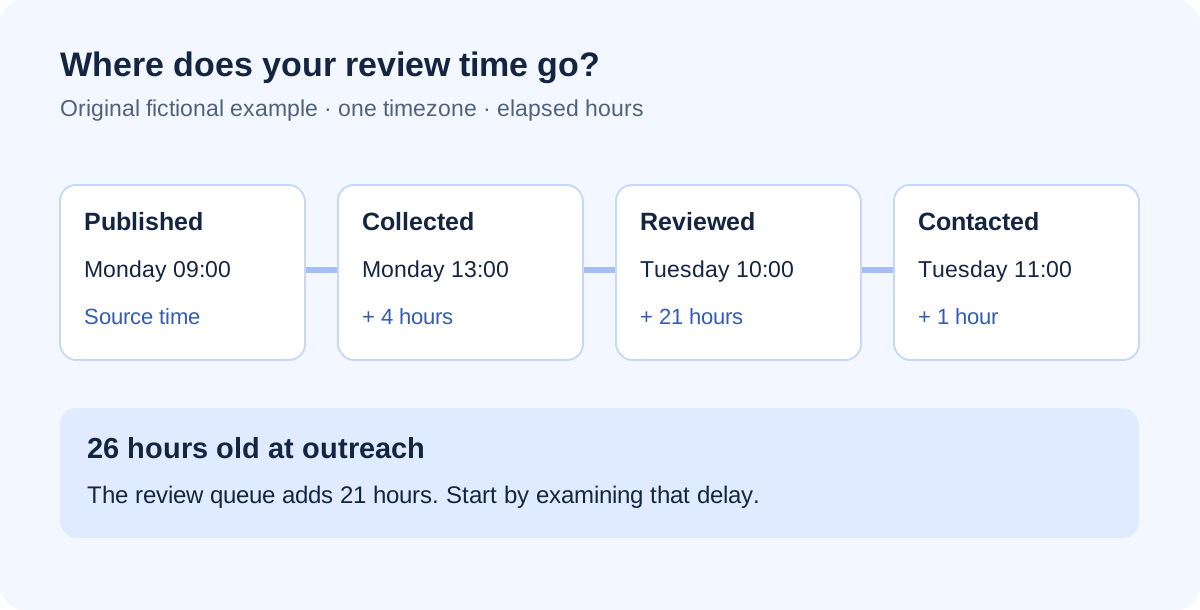
Assign an owner to the review queue before paying for a shorter monitoring interval. A clear review routine can matter more than additional collection opportunities when the team is already leaving relevant evidence unattended.
Compare published scan cadence with coverage and successful activity
At the November 19, 2026 review, Privly's public pricing comparison listed monitoring every 12 hours for Founder, six hours for Sales Team, and three hours for Agency. Treat those as published plan intervals. They do not establish exhaustive LinkedIn coverage, a maximum time to find every post, or a guarantee that each scan returns a relevant prospect.
Ask what is monitored, what makes a source eligible, and where you can inspect recent successful discovery activity. A disconnected source, unavailable post, empty result, and overly narrow audience are different conditions. An apparently quiet feed needs investigation before it can be interpreted as no demand.
Use Privly's troubleshooting guide for the operating checks. Keep the purchasing calculation separate: the intent monitoring cost guide covers plan economics, while this guide evaluates whether the timing is useful.
Distinguish saved-account alerts from discovering new conversations
A team with a named account list may want updates about known people and companies. A team exploring a market may want to discover people discussing a relevant problem. Both can support prospecting, but the underlying coverage is different, so comparing alert counts alone is misleading.
LinkedIn's Sales Navigator alerts documentation describes updates for saved leads and accounts, including role changes and shared activity. Saving the relevant leads and accounts is part of that workflow. Compare it with the scope of any discovery tool before treating the two feeds as equivalent.
A job change or company announcement offers context. It does not establish a purchasing request. When combining known-account alerts and broader discovery, reconcile the people and existing conversations so different reviewers do not independently start the same pitch.
Run a freshness evaluation without pretending you know every post
Choose a short observation period that fits your working routine, then review the actual records surfaced. Log source date, first observed time, review time, evidence type, fit decision, and whether the situation still appears relevant. Record missing dates instead of filling them with collection time.
Summarize the sample by the problems you can act on: slow review, unclear evidence, outdated context, poor fit, or missing dates. If enough dated records exist, calculate source age at review and show the sample size. Do not claim recall or coverage across LinkedIn; you do not know the complete set of relevant posts that could have been found.
Keep rejected matches in the evaluation notes. Excluding them from the review can make a tool look fresher or more relevant than the experience your team actually had. Similarly, a few unusually fast discoveries do not establish a guaranteed detection time.
- Define the audience and problem before comparing tools.
- Separate known dates, observed dates, and unavailable dates.
- Read the current source context before marking a match usable.
- Record fit and unresolved need separately from age.
- Name the largest operational delay and choose one change to evaluate.
Decide when faster monitoring changes the sales task
A same-day request for a specialist may become irrelevant quickly. An ongoing systems review may remain useful after several days. Set the review priority around the situation and your team's ability to respond accurately, rather than applying one universal expiry window to every signal.
For example, a fictional workflow software team reviews new matches every morning. It considers an afternoon review because some prospects are asking active questions about approval processes. The team first checks whether it can assign a knowledgeable responder. If nobody can answer, a faster plan creates a longer queue rather than a better conversation.
Before outreach, recheck later comments and avoid claiming private knowledge. Ask about the observed process without assuming budget, urgency, or dissatisfaction. The freshness score, if a vendor provides one, should be explained in terms of its inputs; it is not a prediction that a person will buy.
Common questions about LinkedIn signal freshness
Does a three-hour interval mean every post appears within three hours?
No. A scan schedule alone does not establish coverage or maximum detection latency. Confirm the monitored scope, connection requirements, successful-run visibility, and any documented service commitment.
Is a newer signal always more valuable?
No. Relevance, audience fit, and whether the need remains unresolved matter. A new unrelated reaction can be less useful than an older, still-active discussion of the exact problem you address.
Can reply rates prove a faster scan is better?
Reply outcomes help evaluate your own workflow, but audience, message, offer, and execution also change them. Do not attribute a difference solely to monitoring speed without controlling those other factors.
Choose a cadence your team can use
Review Privly's monitoring plans alongside your observation log. Choose capacity that supports useful evidence and a review routine your team can maintain.
Sources reviewed November 19, 2026: Privly's pricing and source-date handling, Sales Navigator alerts, and LinkedIn's automated activity rules. LinkedIn restricts third-party scraping and automation on its website; scan frequency does not establish platform permission. The timeline and evaluation method are original illustrative material.
 Agency Reporting
LinkedIn Lead Generation Software With Client Reporting
Compare LinkedIn client reporting software using a practical metrics worksheet, permission checks, attribution rules, and an agency reporting example.
November 19, 2026 · Giress Kenn Ideal Customer Profile
LinkedIn Prospecting Software That Starts With Your Company Website
Turn your company website into a reviewed LinkedIn prospecting brief. Use a profile worksheet, exclusions, and sample-lead review before launching outreach.
November 19, 2026 · Giress Kenn Conversation Management
LinkedIn Prospecting Software With Reply and Conversation Tracking
Evaluate LinkedIn reply tracking with a conversation handoff template, reply handling matrix, permission checks, and follow-up stop tests for sales teams.
November 19, 2026 · Giress Kenn