

LinkedIn Lead Generation Software for Managed IT Service Providers
Published · Giress Kenn
Practical guidance for founders, B2B teams, and small agencies turning buyer signals into reviewed next actions.
Photo by Rodeo Project Management Software on Unsplash
A managed IT provider needs prospects it can support after the contract is signed. Geography, technology environment, service coverage, and onboarding complexity can matter more than whether the person has an IT title. Evaluate LinkedIn lead generation software around service eligibility and a relevant reason to talk. Privly can support the research and outreach workflow, while your technical team validates the delivery requirements.
Quick Answer
Managed IT providers should choose LinkedIn prospecting software by service-area fit, supported environments, evidence quality, and sales follow-through. Privly helps connect reviewed business context with relevant prospects and outreach. Validate technical scope and support expectations before treating an interested reply as an account your team can responsibly onboard.
Start with the service boundary
Define what your contract includes. Remote helpdesk support, on-site work, infrastructure projects, and security services are not interchangeable offers. A campaign should not suggest comprehensive coverage if you provide only a narrow service.
Use Privly’s business profile setup to review the intended company type, geography, and exclusions. If on-site delivery is limited to a region, keep that restriction visible even when the overall business has national ambitions.
A website-derived ICP can help reveal broad positioning. Correct the profile if your website lists services delivered only through partners or under separate agreements.
Which signals justify investigation?
A public discussion of repeated support delays or a changing office footprint can provide context. It does not prove that the incumbent provider is failing or that a contract is open for replacement.
Use buyer-intent monitoring to evaluate the available evidence, then read the original conversation through the opportunity review guide.
Check whether the person describes an actual operational problem or merely comments on a general topic. A technical employee may understand the problem without owning supplier selection. Keep buying authority unconfirmed until the organization explains it.
Separate commercial interest from technical eligibility
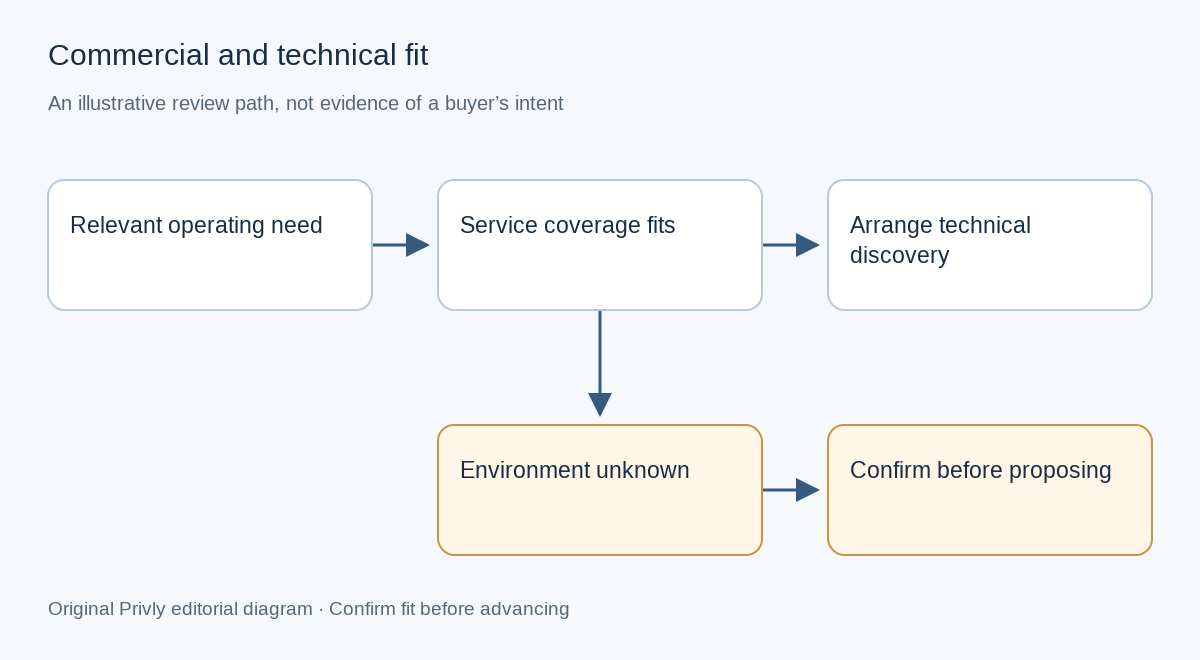
Before offering a detailed proposal, clarify the environment, service expectations, and transition constraints. Do not infer an organization’s stack from its industry or size.
The qualification framework supports reviewing fit and evidence together. Your technical acceptance requirements still need their own validation.
A hypothetical MSP in North Carolina sees an operations leader discussing delays onboarding employees across several offices. The MSP can ask which parts of provisioning create the delay. Before discussing a managed service, it checks support geography and whether the required systems fall within its actual capability.
The example does not assume a specific technical environment, contract value, or resulting sale. It also does not imply that Privly inventories a prospect’s systems.
Make the first offer proportionate to what you know
A conversation about the onboarding process may be appropriate. A claim that you can cut support costs by a fixed amount is not supported by a short public post.
Review the audience and message using the campaign guide. Later follow-ups should not imply an assessment has taken place or that vulnerabilities have been found.
When the prospect replies, use the messages workflow to preserve the actual requirement. Bring in a technical colleague when needed, and avoid turning an early sales exchange into unsupported implementation advice.
Keep existing customers and open opportunities in the eligibility review. A new prospect record does not establish that no colleague already owns the relationship.
What belongs in a software acceptance test?
Ask a salesperson to review a small selection and explain why each organization fits the service. Then ask a technical reviewer to identify missing delivery information.
Inspect the CRM integration scope if records must move into a CRM or service system. A supported contact export does not establish integration with your PSA, ticketing platform, or complete account history.
Compare current plan capacity with actual senders and the people who need review access. Include technical presales time and onboarding capacity in the wider acquisition budget.
If the provider cannot take on another account without degrading service, increasing outbound volume may be the wrong immediate purchase. Use the evaluation to understand appropriate demand, not simply to fill the largest available allowance.
What should an MSP measure?
Count conversations that meet the service boundary, technical reviews worth pursuing, and proposals based on confirmed requirements. Keep these separate from leads discovered and messages sent.
Review rejection reasons. Geographic mismatches call for targeting changes. Unsupported requirements call for clearer qualification. Slow replies from your team call for better ownership.
Also review LinkedIn’s platform policy. Sending controls do not guarantee account safety or approval from LinkedIn.
Managed IT qualification worksheet
Use this record for one offer and one audience. The examples are illustrative; they do not describe a Privly customer or guarantee an outcome.
| Review area | Record the observation | Resolve before advancing |
|---|---|---|
| Service area | Supported geography and response model | Is onsite coverage required? |
| Environment | Buyer-confirmed technology requirements | Does the supported stack match? |
| Commercial fit | A described operating need and responsible contact | What is the contract or buying situation? |
| Next step | A scoped technical discovery conversation | Can onboarding capacity support the work? |
FAQ
Does Privly discover a prospect’s complete IT environment?
Do not assume so. The reviewed sources support prospecting evidence and outreach, not technical asset discovery.
Can a regional MSP target nationally?
Only where its actual service model supports the accounts it targets. Review on-site and support requirements before broadening the audience.
Should every technical complaint trigger a sales message?
No. Confirm context, role, fit, and whether the proposed approach would be useful rather than speculative.
Does a CRM connection include our PSA integration?
Not necessarily. Verify the exact destination and fields instead of inferring support from a general integration claim.
Evaluate leads against your service promise
Review your ICP with Privly, then test prospects against the support coverage and technical scope your team can deliver.
Sources and further reading
The linked product guides describe the workflow; confirm current availability and terms before choosing a plan. Examples and worksheets are illustrative, not customer results.
LinkedIn’s automated activity policy restricts automated activity. Vendor settings do not grant platform permission.
 Bootstrapped Startups
LinkedIn Lead Generation Software for Bootstrapped Startups
Choose LinkedIn prospecting software around runway, founder time, qualified conversations, and the cost of a realistic first campaign.
November 25, 2026 · Giress Kenn Marketing Agencies
LinkedIn Client Acquisition Software for B2B Marketing Agencies
Choose LinkedIn acquisition software for your agency’s own pipeline by offer fit, buying evidence, sales ownership, and proposal quality.
November 25, 2026 · Giress Kenn Appointment Setting
LinkedIn Outreach Software for Appointment-Setting Agencies
Evaluate appointment-setting software by meeting definitions, client evidence, sender access, reply handling, and sales handoff quality.
November 25, 2026 · Giress Kenn