

LinkedIn Client Acquisition Software for Web Design Agencies
Published · Giress Kenn
Practical guidance for founders, B2B teams, and small agencies turning buyer signals into reviewed next actions.
Photo by charlesdeluvio on Unsplash
An outdated-looking website is not proof that its owner wants a redesign. A design agency needs to understand the business objective, the decision maker, and the conditions required to deliver the project. Choose prospecting software that helps find a relevant reason to investigate and prepare an accurate approach. Privly can support the research-to-conversation workflow, but your agency must validate the design and implementation brief.
Quick Answer
Web design agencies should evaluate LinkedIn client acquisition software by buyer context, project fit, and the quality of the first conversation. Privly supports reviewed prospecting and outreach from relevant evidence. Look for a stated business need, and avoid treating a visual opinion about a website as proof of lost revenue or redesign intent.
Start with the kind of website engagement you deliver
A marketing-site redesign, e-commerce implementation, migration, and ongoing design support involve different requirements. Specify the work your team provides before selecting an audience.
Use the business profile guide to review the offer and exclusions. If you do not provide copywriting, complex integrations, or ongoing maintenance, avoid language that implies those services are included.
The free ICP identifier can help you compare your website’s positioning with the projects you want. Correct an overly broad audience instead of assuming every business with a website is a suitable prospect.
Which business events can support a relevant conversation?
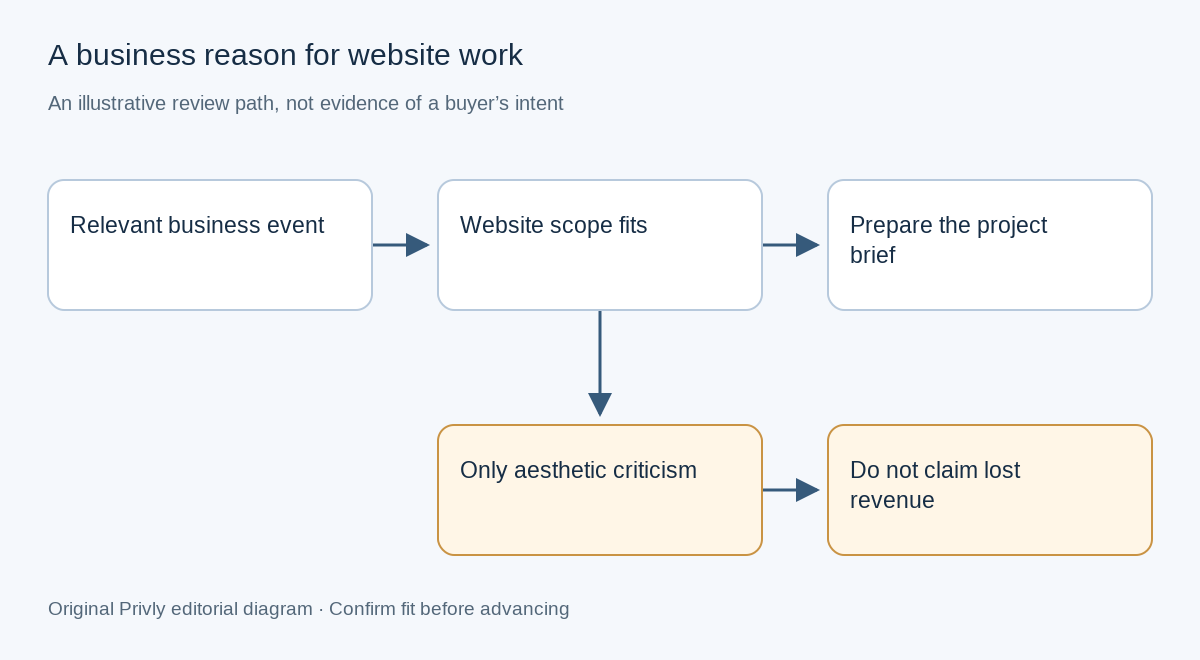
A company discussing a new offer, a repositioning, or difficulty updating its site may have a relevant problem. The next step is to understand what the change requires, not to assume a complete redesign is necessary.
Evaluate buyer-intent monitoring for public context, then inspect the source using the opportunity review guide.
A founder announcing a new product may already have a design partner. A marketing manager describing publishing delays may need a workflow change rather than a new site. Read the evidence before deciding what to offer.
Avoid turning aesthetic criticism into a performance claim
You can describe an observable design issue, but you cannot infer lost sales from appearance alone. Do not claim a conversion uplift, accessibility violation, or search penalty without appropriate evidence.
The qualification overview is useful for separating a relevant situation from an unsupported conclusion. Keep commercial fit and the actual project requirement distinct.
For a hypothetical U.S. web agency, a buyer’s post about difficulty publishing new service pages could justify asking about the current content workflow. It would not justify saying that the entire website is costing the company customers.
If a technical or accessibility assessment is part of your offer, define its scope and perform it through an appropriate process. Do not imply that Privly has performed that assessment.
Offer a next step the buyer can evaluate
A focused discussion of publishing requirements or a scoped review of a landing page may be easier to assess than a generic “free website audit.” Explain what the buyer will receive and what the review does not establish.
Use the campaign workflow to review the message and follow-ups. Make sure they describe your actual service and do not invent familiarity with the buyer’s analytics.
A fictional agency in Oregon sees a marketing lead describe a planned service launch and a slow website update process. The agency asks whether the obstacle is content ownership or implementation access. If the person wants help, the agency discusses a bounded discovery step.
This is an illustrative approach, not a client result or a promise that the software will identify every redesign opportunity.
Qualify the project before preparing a proposal
Clarify the intended outcome, platform, content responsibilities, required integrations, decision process, and launch constraints. A suitable company may still be a poor fit for your delivery model.
Use the leads and messages guide to preserve the conversation and commitments. Keep the actual design brief in the agency’s agreed project-discovery record.
The consulting use case reinforces why prerequisites matter. If the client cannot supply content or grant required access, the project timeline needs to reflect that rather than assuming those inputs will appear.
Do not treat a request for pricing as a completed brief. Clarify what is being priced before comparing the opportunity with other work in the pipeline.
What should a software pilot measure?
Evaluate whether the team can identify relevant context, qualify the project, and move a suitable conversation toward a scoped next step. Count those outcomes separately from leads and connection acceptances.
Compare current plan allowances with the people who will review prospects and handle replies. Include discovery and proposal time in your acquisition cost model.
If records need to move into a CRM, inspect the integration guide. A contact export does not establish transfer of design requirements, assets, approvals, or project tasks.
A useful tool should make the first commercial decision better informed. It cannot replace creative judgment, technical discovery, or the client’s approval of a project.
Website project brief
Use this record for one offer and one audience. The examples are illustrative; they do not describe a Privly customer or guarantee an outcome.
| Review area | Record the observation | Resolve before advancing |
|---|---|---|
| Business event | A new service or a buyer-described publishing issue | Is a website change part of the response? |
| Scope | Design, content, platform, and integration boundaries | Who owns copy, approvals, and access? |
| Evidence | The buyer’s stated problem | Appearance alone establishes no revenue loss |
| Next step | A bounded website discovery conversation | Can the project fit budget, timing, and delivery capacity? |
FAQ
Does an old website prove redesign intent?
No. Appearance alone does not establish a budget, priority, or willingness to change. Look for relevant context and clarify the actual need.
Can we promise a conversion improvement in outreach?
Only make claims you can substantiate in the specific context. Do not apply another client’s outcome as a guarantee for a new prospect.
Does Privly audit website accessibility or performance?
The reviewed sources establish prospecting and customer-profile workflows, not a technical website audit. Evaluate those requirements separately.
What is a useful first offer?
A clearly scoped next step addressing the problem the buyer actually described, with honest boundaries about what will be reviewed and delivered.
Find a business reason for the design conversation
Start with Privly’s ICP tool, review your agency’s offer, and test whether the resulting prospects fit the projects you want to deliver.
Sources and further reading
The linked product guides describe the workflow; confirm current availability and terms before choosing a plan. Examples and worksheets are illustrative, not customer results.
LinkedIn’s automated activity policy restricts automated activity. Vendor settings do not grant platform permission.
 Bootstrapped Startups
LinkedIn Lead Generation Software for Bootstrapped Startups
Choose LinkedIn prospecting software around runway, founder time, qualified conversations, and the cost of a realistic first campaign.
November 25, 2026 · Giress Kenn Marketing Agencies
LinkedIn Client Acquisition Software for B2B Marketing Agencies
Choose LinkedIn acquisition software for your agency’s own pipeline by offer fit, buying evidence, sales ownership, and proposal quality.
November 25, 2026 · Giress Kenn Appointment Setting
LinkedIn Outreach Software for Appointment-Setting Agencies
Evaluate appointment-setting software by meeting definitions, client evidence, sender access, reply handling, and sales handoff quality.
November 25, 2026 · Giress Kenn