

The Agency Guide to Scaling LinkedIn Outreach Across Multiple Clients
Published · Zyaam Ali
Practical guidance for founders, B2B teams, and small agencies turning buyer signals into reviewed next actions.
Photo by Kaleidico on Unsplash
Your agency can win another LinkedIn outreach client this month. Can it also research that client’s audience, review the campaign, handle the replies, and report the results without slowing everyone else down? Scaling LinkedIn outreach across multiple clients starts with delivery capacity. This guide shows how to measure workload, delegate decisions, calculate direct delivery costs, and add clients in stages while keeping each client’s context separate.
Scale delivery capacity before adding sending volume
Agency growth adds more than LinkedIn profiles. Each new client brings another audience, offer, reviewer, sales handoff, and set of exceptions. A founder-led campaign may work because one person remembers all the context. That memory becomes a bottleneck when several operators need to make the same decisions.
Treat capacity as the amount of client work the team can complete with its review and response commitments intact. Count research, copy review, reply triage, reporting, client communication, and rework. Sending volume is an activity measure; it does not tell you whether interested prospects will receive useful answers.
For the setup of separate workspaces and sender ownership, start with our multi-client LinkedIn outreach guide. This article focuses on the next decision: whether the delivery team can responsibly take on another client.
Measure where the current team’s hours go
For a representative working period, log time by client and task. Separate planned delivery from avoidable rework: correcting the wrong list, finding missing approval, reconstructing a report, or asking the founder to answer a question already covered in the brief. Record onboarding effort separately because it may be much higher than steady-state delivery.
Look at the slowest stage, not just the total hours. A team may have research capacity but no available reviewer. A client may be waiting on specialist answers while campaign activity continues. Fix that bottleneck before treating unused sender capacity as permission to grow.
| Work category | Record | Decision it informs |
|---|---|---|
| Research and qualification | Hours, prospects reviewed, and rejected reasons | Whether targeting is clear enough to delegate |
| Copy and approval | Operator time plus time waiting for client feedback | Whether review is blocking launch |
| Conversation handling | Reply workload, owner, and unresolved questions | Whether the team can meet response commitments |
| Reporting and handoff | Reconciliation time and client-confirmation delays | Whether outcomes can be reported accurately |
| Rework and incidents | Hours and root cause | Which repeated mistakes need a process change |
Build a client-capacity worksheet with a reserve
Start with the hours operators can actually allocate, after leave and other responsibilities. Subtract shared work and a reserve for uneven replies, onboarding, and interruptions. Then compare the remaining hours with the workload of existing clients and the proposed client. Use your own measurements; an average clients-per-operator claim cannot describe every agency.
| Item | Hours per week | Calculation |
|---|---|---|
| Allocated team time | 60 | 2 operators × 30 hours |
| Shared meetings and administration | 8 | Subtract from allocated time |
| Reserve for variability | 10 | Illustrative planning choice |
| Available for planned client delivery | 42 | 60 − 8 − 10 |
| Existing client commitments | 30 | Measured estimate in this example |
| Proposed new client | 8 | Steady-state estimate; onboarding separate |
| Remaining planned capacity | 4 | 42 − 30 − 8 |
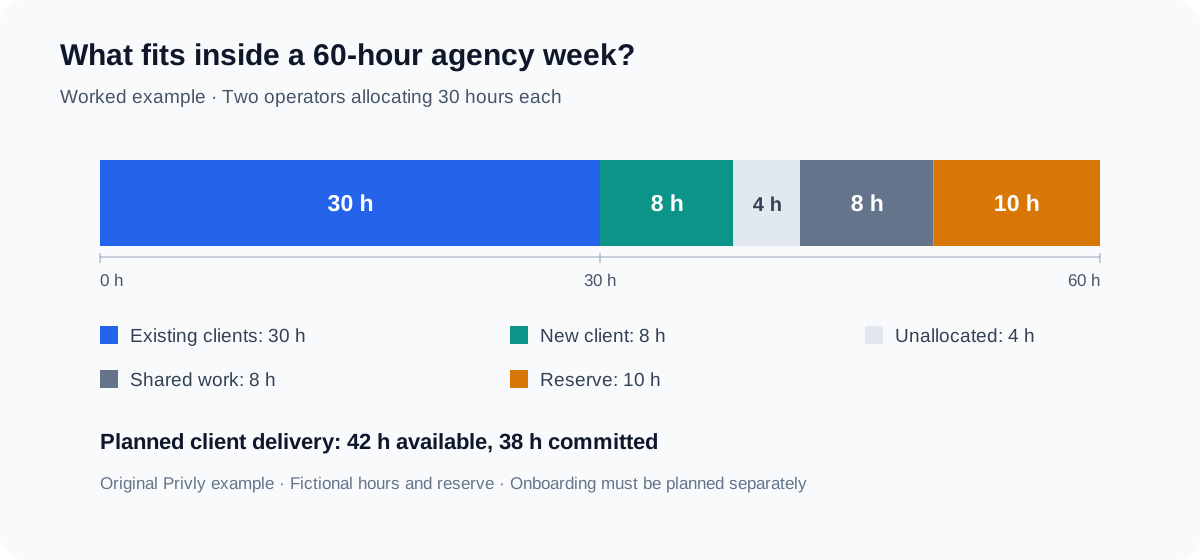
The worksheet leaves room for the new client’s steady-state work, but it does not establish that onboarding fits. Schedule that work explicitly. Repeat the calculation for each specialist role: spare researcher hours cannot substitute for an unavailable client reviewer or sales owner.
Use agency financial benchmarks as context
Promethean Research’s 2026 Digital Agency Industry Report reports an average digital-agency net margin of 13% for 2025. Its public overview does not disclose the sample behind that figure. This describes broader agency economics, not LinkedIn-outreach service profitability or a target every agency should achieve.
The practical implication is to track the cost of delivering the service alongside client count. A new retainer can add revenue and still create a worse business if it brings unpriced research, specialist calls, or continual revisions. Check your actual delivery records rather than treating tool consolidation as a guaranteed margin improvement.
Delegate decisions with a named owner and an escalation rule
Make responsibilities specific enough that the founder does not become the default answer to every question. A researcher can propose prospects using the client’s criteria; a strategist can review fit and messaging; an operator can manage the approved campaign; the client’s sales owner can confirm commercial details and accept a handoff.
Delegation needs both instructions and actual access. Check what someone can see, manage, and send in the product. Keep permissions scoped to assigned clients and authorized senders. Train a backup owner for time-sensitive conversations so leave or illness does not create an unowned inbox.
| Decision | Responsible owner | Escalate when |
|---|---|---|
| Add a prospect | Researcher applying reviewed criteria | Evidence is missing or a required fit condition fails |
| Change audience or claims | Strategist plus client reviewer | The approved campaign meaning changes |
| Run the reviewed sequence | Authorized campaign operator | The sender, workspace, or connection is wrong |
| Answer product or pricing questions | Client specialist | The approved brief does not support an answer |
| Confirm an opportunity | Client sales owner | Fit or the agreed next step is unresolved |
A vendor’s role label is not enough to judge access. HeyReach’s permissions documentation describes dependent permissions and workspace-wide inbox visibility. Review the actual access model of your chosen tool. In Privly, consult the workspace access guide before delegating campaign work.
Calculate direct delivery costs before promising a service level
Define the service you are pricing: audience research, campaign preparation, review rounds, conversation triage, reporting, and any client meetings. State what happens when the offer changes or the client asks for another audience. A service scope should make the work predictable without reducing personalization to a token name change.
| Item | Calculation | Amount |
|---|---|---|
| Client fee | Illustrative monthly retainer | $2,500 |
| Direct labor | 8 hours/week × 4-week planning month × $45/hour | $1,440 |
| Allocated tools | Illustrative client allocation | $150 |
| Contribution after these direct costs | $2,500 − $1,440 − $150 | $910 |
| Contribution rate | $910 / $2,500 | 36.4% |
This is a fictional four-week planning example, not a pricing recommendation. The contribution excludes shared overhead, sales costs, onboarding, tax, and other expenses; it is not net profit and cannot be compared directly with the reported agency net margin. At 12 direct hours per week with the same assumptions, contribution falls to $190, or 7.6%. Tracking workload makes that change visible before you add another client.
Expand through operational gates, not an account-count target
Add a client when the team can explain the available hours, review ownership, sender access, reply coverage, and reporting process. Give onboarding a named owner and a scheduled slot. Check the first campaign before making further expansion commitments.
After launch, compare estimated workload with actual work. Watch for approval backlog, unanswered conversations, repeated copy corrections, missed reporting, and rising rework. Decide in advance what would pause further onboarding. These are operating signals, not a claim that one fixed staffing ratio is safe for every agency.
- Before onboarding: client scope, allocated hours, setup owner, and required access are clear.
- Before launch: the audience, sender, claims, sequence, and client handoff are reviewed.
- Before the next expansion: actual hours fit the plan and response commitments are being met.
- If the plan fails: identify the bottleneck, adjust scope or capacity, and agree the next review.
Make consolidation remove repeated work
Privly brings business-profile review, evidence-led lead qualification, lists, messages, and campaigns into a connected workflow. Keep each client in its own workspace, prepare outreach from that client’s reviewed context, choose Manual or Outreach Autopilot, and export selected leads as CSV when a file handoff is needed.
Use that continuity to reduce repeated copying and reconstruction. Measure the time saved in your own delivery process. Keep client approval, specialist answers, and sales-outcome confirmation owned by people; a consolidated platform does not remove those responsibilities.
For an operator-ready launch routine, use the multi-client LinkedIn outreach playbook. For the audience brief, use the B2B ICP template. Start a new client’s targeting with Privly’s ICP identifier.
Research checked October 5, 2026: Promethean Research’s Digital Agency Industry Report and HeyReach’s role-based permissions documentation, linked above. The capacity allocation, cost calculations, and decision map are original examples. No client results or measured efficiency gains are claimed.
 Demand Generation
Managing Multi-Client LinkedIn Outreach: A Demand Gen Agency Playbook
Run client LinkedIn campaigns with a reusable campaign record, prospect review, approval checklist, reply routing, CSV handoff, and weekly reporting routine.
October 5, 2026 · Zyaam Ali Demand Generation
How Demand Gen Agencies Can Manage LinkedIn Outreach for Multiple Clients
Manage LinkedIn outreach across agency clients with separate workspaces, client approvals, sender ownership, reply handoffs, and a practical reporting template.
October 5, 2026 · Zyaam Ali Ideal Customer Profile
B2B Ideal Customer Profile Template: Examples for SaaS and Agencies
Create a B2B ideal customer profile with a practical template, SaaS and agency examples, sourced statistics, and customer analytics to test your assumptions.
September 30, 2026 · Giress Kenn