

LinkedIn Prospecting Software for Cybersecurity Companies
Published · Giress Kenn
Practical guidance for founders, B2B teams, and small agencies turning buyer signals into reviewed next actions.
Photo by Vitaly Gariev on Unsplash
Cybersecurity outreach can lose credibility when it jumps from a public comment to a claim about a company’s exposure. A prospect discussing security operations has not necessarily disclosed an incident, a control failure, or an active procurement project. Choose prospecting software that helps preserve evidence and uncertainty. Privly can support research and reviewed outreach; your team remains responsible for the technical and commercial claims it makes.
Quick Answer
Cybersecurity companies should evaluate LinkedIn prospecting software by source context, buyer fit, claim accuracy, and technical handoff quality. Privly supports evidence-based prospect review and campaign preparation. Use public discussion to frame a relevant question, not to assert an undisclosed breach, missing control, compliance failure, or confirmed purchase without supporting evidence.
Define the buying problem precisely
A security platform, an assessment service, and an incident-response engagement address different situations. A generic audience of security leaders does not establish which offer is appropriate.
Review the business profile around the specific product or service. Identify supported environments, the people involved, and exclusions. Do not describe implementation support or certifications that your company cannot substantiate.
The free ICP identifier can provide a starting description, but a technical seller should review it. Broad website language can obscure important product boundaries.
What counts as useful public context?
A discussion of alert triage, access reviews, or vendor evaluation may support further research. The significance depends on what the person actually said and whether the context remains current.
Evaluate buyer-intent monitoring for evidence that your team can inspect. Use the opportunity review guide to open the source rather than relying on a summary alone.
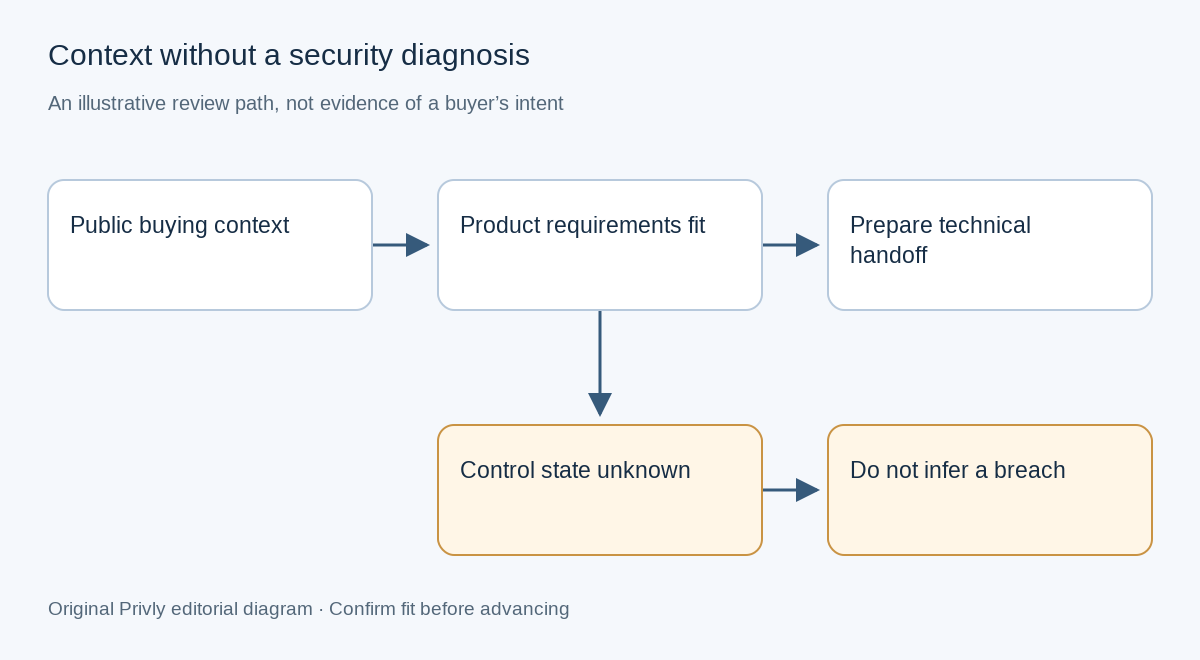
Do not turn a general industry discussion into a company-specific diagnosis. A person sharing an article about ransomware has not disclosed that their employer was attacked. A request for product recommendations does not establish budget or procurement authority.
How should you qualify the technical fit?
Separate the relevant problem from the product prerequisites. A prospect may describe exactly the problem you address while using an environment your product does not support.
Privly’s qualification overview provides a framework for reviewing fit, timing, and evidence. Keep technical requirements unresolved until verified through appropriate sources or a conversation.
A hypothetical U.S. identity-security vendor sees a security manager discussing slow access reviews. The vendor asks about the review workflow. Before proposing a demonstration around a specific integration, the seller confirms that the integration is supported and relevant.
This example does not imply that Privly detects security weaknesses or verifies a company’s controls. It illustrates how to move from public context to a responsible qualification question.
What should a credible first message avoid?
Avoid fear-based claims that outrun the evidence. Do not imply that you scanned the company, found exposed assets, or know about an incident unless that is true and appropriately supported.
A useful opening can ask about the process the buyer described and offer a relevant next step. It should make clear what your company actually provides.
Review messages through the campaign workflow, especially later steps. An initial draft may be careful while a follow-up introduces an unsupported claim about urgency or risk.
If the buyer raises a technical question, preserve it in the conversation workflow and involve the qualified technical owner. Do not use a generated message as a substitute for an accurate answer.
How should the handoff to technical sales work?
Carry the buyer’s stated problem, confirmed environment, open requirements, and promised next action. Clearly distinguish the buyer’s words from the seller’s interpretation.
Keep confidential architecture details and sensitive assessment information in the systems your organization has approved for them. A prospecting record is not automatically the right destination for every technical document exchanged during evaluation.
Verify CRM exchange before assuming those details synchronize. Selected-contact export does not establish a full technical evaluation record.
The acceptance test is whether the technical colleague can understand the question without the prospect repeating everything. That is an operating goal to test, not a verified automatic handoff feature.
What should determine the purchase?
Compare plan capacity with review workload and the number of sales conversations your team can support. An allowance for more records is not proof of better technical fit.
During evaluation, inspect why prospects were rejected. Unsupported environments, irrelevant topics, and unclear ownership point to different improvements. Preserve those reasons rather than summarizing every rejection as a bad lead.
Also distinguish LinkedIn’s automation policy from vendor execution controls. Neither a sending limit nor a security-oriented use case establishes permission to automate platform activity.
Cybersecurity opportunity record
Use this record for one offer and one audience. The examples are illustrative; they do not describe a Privly customer or guarantee an outcome.
| Review area | Record the observation | Resolve before advancing |
|---|---|---|
| Observed context | A public statement about a relevant business problem | Does it relate to this specific product? |
| Technical fit | Buyer-confirmed integration requirements | What requires a technical specialist? |
| Evidence boundary | Exact public source and date | No breach, vulnerability, or control gap is established |
| Handoff | Agreed question, owner, and next conversation | Which sensitive details need an approved channel? |
FAQ
Does Privly identify breaches or vulnerabilities?
The reviewed documentation establishes buyer-context research and prospecting, not breach detection or vulnerability assessment.
Can we personalize around a public security incident?
Only with accurate, appropriately sourced context and a relevant approach. Do not invent affected systems, exposure, or remediation needs.
Does a security title identify the budget owner?
No. Clarify the evaluation and purchasing roles rather than assuming authority from seniority.
What should a pilot establish?
That the team can find relevant context, qualify technical fit, prepare accurate outreach, and hand a real question to the right specialist.
Evaluate evidence before increasing outreach
Explore Privly’s qualification workflow and test it against one specific security offer and supported environment.
Sources and further reading
The linked product guides describe the workflow; confirm current availability and terms before choosing a plan. Examples and worksheets are illustrative, not customer results.
LinkedIn’s automated activity policy restricts automated activity. Vendor settings do not grant platform permission.
 Bootstrapped Startups
LinkedIn Lead Generation Software for Bootstrapped Startups
Choose LinkedIn prospecting software around runway, founder time, qualified conversations, and the cost of a realistic first campaign.
November 25, 2026 · Giress Kenn Marketing Agencies
LinkedIn Client Acquisition Software for B2B Marketing Agencies
Choose LinkedIn acquisition software for your agency’s own pipeline by offer fit, buying evidence, sales ownership, and proposal quality.
November 25, 2026 · Giress Kenn Appointment Setting
LinkedIn Outreach Software for Appointment-Setting Agencies
Evaluate appointment-setting software by meeting definitions, client evidence, sender access, reply handling, and sales handoff quality.
November 25, 2026 · Giress Kenn