

LinkedIn Lead Generation in Canada: A B2B Prospecting Guide
Published · Giress Kenn
Practical guidance for founders, B2B teams, and small agencies turning buyer signals into reviewed next actions.
Photo by Andre Furtado on Unsplash
Your prospect list says Canada, but the first company only serves another market, the contact has moved roles, and the message assumes everyone works on Toronto time. Useful LinkedIn lead generation in Canada starts with a precise market and a reason to approach each person. This guide shows how to choose a Canadian segment, verify fit, prepare a relevant conversation, and measure what happens next.
Choose a Canadian market you can actually serve
Canada is a geographic boundary, not an ideal customer profile. A software team selling to accounting firms has a different buying group and delivery process from a consultant serving manufacturers. Start with one offer, the problem it resolves, and the company characteristics that make delivery practical.
Decide what Canadian means for this campaign: headquarters in Canada, an operating location in a named province, or a buyer responsible for a Canadian business unit. Record the rule before searching. A contact living in Canada does not establish that their employer buys locally, and a global company can have a relevant Canadian team.
Add working language, service coverage, required systems, and the time zone relevant to the conversation. Ask how the buyer prefers to communicate rather than inferring language from a surname or province. Keep eligibility and communication preferences separate in the review record.
Turn the market choice into a research worksheet
Use the same fields for every candidate so another teammate can explain why the person belongs in the list. Distinguish a confirmed fact from a useful search assumption. If the account meets your location rule but the relevant role is missing, continue research rather than inventing a decision-maker.
| Field | Example decision | Evidence to check |
|---|---|---|
| Offer | Reporting-workflow review for B2B SaaS teams | Supported systems and deliverable agreed by your business. |
| Market | Companies with a Canadian revenue operations team | Company site and current team context. |
| Person | Owner or contributor to reporting operations | Current role and responsibility beyond the job title. |
| Relevant problem | Repeated pipeline reconciliation work | A dated statement or a buyer conversation. |
| Exclusions | Customers, active opportunities, unsupported systems | Your team’s current records. |
| Communication | Preferred language and meeting time zone | Confirm with the person when arranging the next step. |
Use the ICP template for the full company brief. The lead-scoring guide helps keep fit and buying evidence separate.
From evidence to the next action
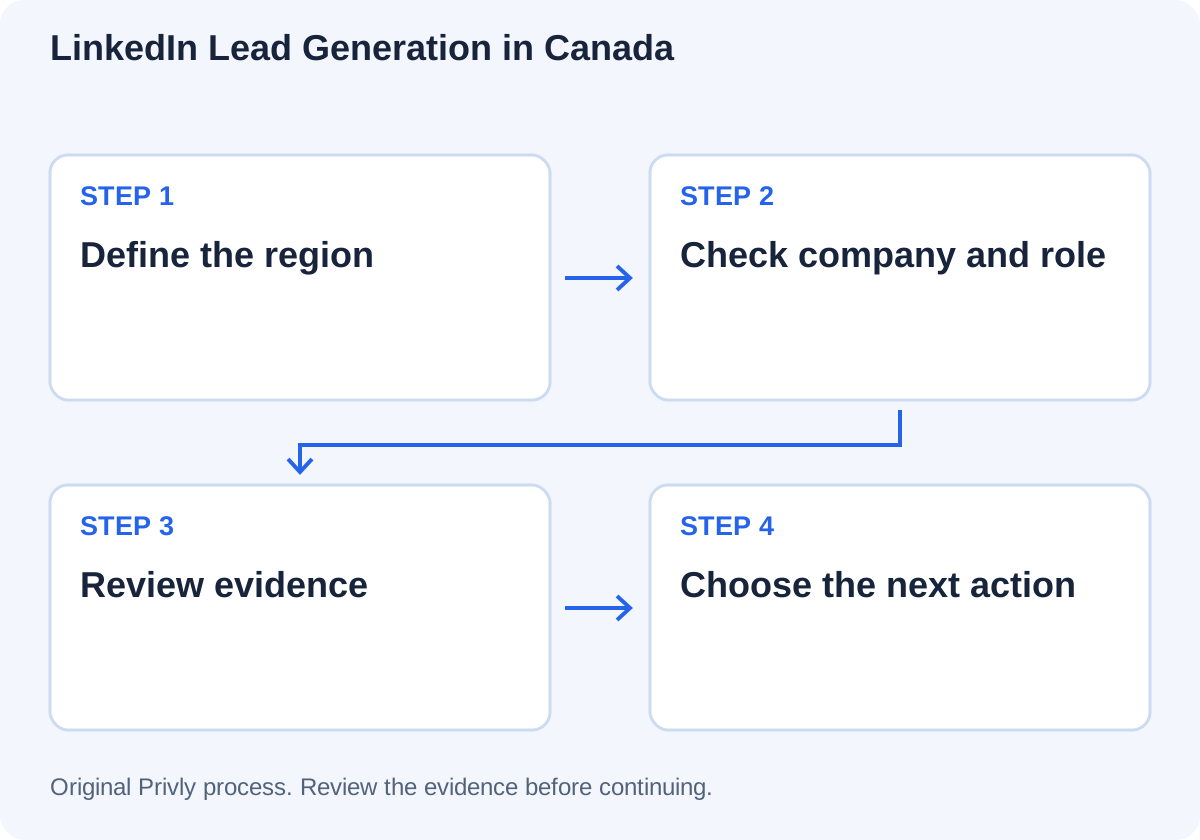
Verify the person and the reason before writing
Check the company domain, the person’s current role, and the date of any source you plan to mention. A public post about a former employer is not evidence of a problem at the current company. Keep the source link and observation date in your research notes.
A funding round, hiring post, or local office opening can suggest where to investigate. It cannot confirm a need for your offer. Give the strongest current evidence priority, then write down what remains unknown: requirements, ownership, budget, or timing. Several copies of the same announcement are one event.
Prepare an appropriate first conversation
Your message should make the connection between the observed situation and the offer easy to understand. Use the sender’s real commercial relationship and a question the person can answer. Avoid claiming shared local experience, customers, or results you cannot substantiate.
Before sending, review the message type and your basis for contacting that person. Canadian location is not permission to send commercial messages. Keep the permission decision with the outreach record instead of treating a publicly visible profile as consent.
CASL section 6 establishes requirements for commercial electronic messages, subject to its exceptions. Use our CASL and outbound sales guide to work through email and LinkedIn message scenarios.
Use the LinkedIn outreach strategy for connection notes and follow-ups rather than building a separate sequence for every province.
Measure the segment, then improve one decision
Track unique people through research acceptance, messages sent, replies, positive conversations, and held qualified calls. Count connection requests separately from direct messages. A polite refusal is a reply but not positive interest.
Compare the same observation window and keep pending future meetings out of a completed-call denominator. For example, 6 positive replies among 60 messaged people is 10%; it is not a 10% meeting rate. This is a worked calculation, not a Canadian benchmark.
Review the underlying reasons when results differ by segment. A smaller region may have fewer suitable accounts; a language mismatch or unsupported requirement may explain rejection. Change the audience rule, offer, or message one at a time so the next batch teaches you something.
Questions about Canadian LinkedIn prospecting
Start with Privly’s free ICP identifier, review the suggested market and exclusions, then use the worksheet to build your first Canadian segment.
Research and source notes
Sources reviewed October 23, 2026. Examples and calculations are authored illustrations; vendor documentation describes capabilities rather than comparative performance.
 CASL
CASL and Outbound Sales: Email and LinkedIn Prospecting in Canada
Review Canadian outbound email and LinkedIn messaging under CASL with official sources, consent and exemption distinctions, and a practical evidence checklist.
October 23, 2026 · Zyaam Ali Canadian B2B
Best LinkedIn Prospecting and Outreach Tools for Canadian Teams
Choose LinkedIn prospecting tools for a Canadian team with a sourced shortlist, CAD pricing context, review controls, and a practical selection worksheet.
October 23, 2026 · Giress Kenn AI Prospecting
AI Outreach Tools vs Manual Prospecting: Which Workflow Fits?
Compare AI-assisted and manual prospecting by task, review effort, evidence quality, and cost with a fair pilot plan and worked example.
October 23, 2026 · Zyaam Ali