

B2B Lead Scoring: A Fit and Intent Model for Small Teams
Published · Privly Team
Practical guidance for founders, B2B teams, and small agencies turning buyer signals into reviewed next actions.
Your lead list contains a founder who likes your posts, an operations manager comparing tools, and a company that just raised funding. Who deserves attention first? A useful B2B lead scoring model makes that decision explainable. This guide gives small SaaS sales teams a simple scorecard for customer fit and buying intent, with research, worked examples, and a review process you can run in a spreadsheet.
What is B2B lead scoring?
B2B lead scoring is a repeatable way to prioritize prospects using explicit criteria. Customer fit asks whether you can serve the company and the person. Buying intent asks what evidence suggests they are working toward a relevant purchase. Keep those answers visible separately so a busy prospect cannot accumulate enough activity points to hide a poor fit.
Scoring decides what to review first. Qualification checks the situation with the buyer: their requirements, stakeholders, timing, and ability to proceed. A high score gives you a reason to investigate; it does not complete that conversation.
This separation also appears in HubSpot’s lead-scoring documentation, which distinguishes fit, engagement, and combined scores. Engagement records activity. For the model below, intent requires context about an actual problem or decision.
Three buyer statistics that shape the scorecard
Before choosing points, consider what buyers say about relevance and when they involve sellers. These findings help explain why the scorecard asks for evidence and context.
| Finding | Source and scope | Our takeaway |
|---|---|---|
| 73% said they avoid suppliers that send irrelevant outreach. | Gartner, June 2025: survey of 632 B2B buyers, August–September 2024. | Require a credible connection between the buyer’s situation and your offer. |
| First seller contact occurred 61% of the way through the buying journey, on average. | 6sense, 2025 Buyer Experience Report: a global survey of nearly 4,000 B2B buyers. | Limited visible engagement can coexist with substantial research elsewhere. |
| 95% of purchases went to a vendor on the buyer’s initial shortlist. | 6sense, same 2025 study | An active evaluation may already have a favorite. Ask what still needs resolving. |
These are reported buyer experiences, not a test of lead-scoring performance. The 6sense sample required a purchase of at least $25,000 in the previous two years, with a median purchase between $200,000 and $300,000. Use it as context for considered B2B purchases; it does not establish conversion rates for inexpensive self-service SaaS.
Step 1: Define customer fit before assigning points
Start with one offer and one buyer group. For our worked example, imagine a SaaS tool for client handoffs at B2B agencies. Its target is an operations owner at an agency with 10–100 employees, using a supported project-management system. Solo consultants and companies needing an unsupported integration are outside this example’s scope.
Give one fit point for each confirmed criterion below, for a score from 0 to 4. Store unknown answers as unknown, worth no points until confirmed. If a required criterion fails, exclude the prospect from this offer instead of letting other points compensate. A low score caused by missing information means research is needed.
| Criterion | Evidence to record | Points |
|---|---|---|
| Relevant use case | The agency manages client handoffs your product supports. | 1 if confirmed |
| Company matches the target | B2B agency; 10–100 employees in this example. | 1 if confirmed |
| Person owns or influences the work | Operations responsibility, verified beyond a vague title. | 1 if confirmed |
| Delivery requirements are compatible | Required integrations and service region are supported. | 1 if confirmed |
These points are a starting rubric for the example business, not statistically estimated weights. Adapt the criteria to your offer. Keep a refusal or do-not-contact instruction as a separate stop condition that overrides every score.
Step 2: Score the strongest current buying-intent evidence
Use a separate intent score from 0 to 3. Choose the strongest supported level; do not add points for every appearance of the same event. A post, its repost, and a screenshot can all describe one buying decision.
| Level | What you actually observed | What remains unknown |
|---|---|---|
| 0 — no observed need | A like, a funding announcement, or a broad industry post. | Whether there is a relevant problem or purchase project. |
| 1 — relevant problem | The person describes unresolved client-handoff delays. | Whether they want to change the workflow or buy software. |
| 2 — active evaluation | They ask for tools that solve the handoff problem and name requirements. | Budget, decision process, and whether your offer fits. |
| 3 — explicit purchase discussion | They request a demo, quote, or vendor recommendation for a defined project and stated timing. | Final approval and the remaining buying conditions. |
Zero means you have no qualifying evidence. It does not mean the person is definitely out of market. A job change or funding round may guide research, but cannot tell you which product the company wants. Likewise, a company-level research signal cannot establish which employee is evaluating a purchase.
Save the source link, publication date, observation date, short evidence excerpt, and your interpretation in separate fields. For more examples of evidence strength, use our B2B buying signals guide.
Step 3: Give each score a clear next action
Keep the result as a pair, such as fit 4 / intent 2. Adding it into a total hides why the prospect deserves attention. Review source freshness and exclusions before applying the matrix below.
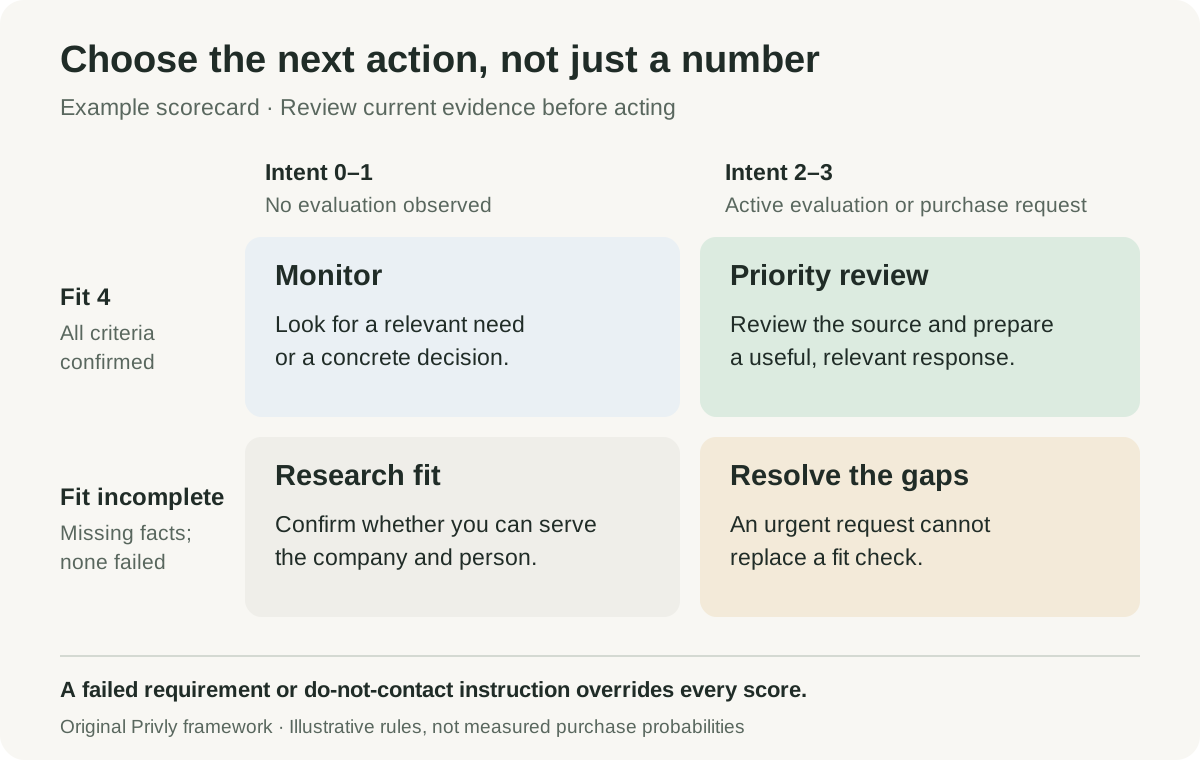
For confirmed fit and active evaluation, prepare a useful response to the stated requirement. For confirmed fit without an evaluation, monitor or contribute useful information where appropriate. If fit is incomplete, verify the missing facts first. If a requirement fails, stop pursuing this offer even when intent is strong.
Add a next-review date based on the evidence. A procurement deadline tells you more than a generic age limit. Recheck an older recommendation request before using it; the project may be closed. If the evidence has expired, retain its history and mark intent as needing review rather than keeping the lead in the priority queue.
Worked example: score three agency prospects
These fictional prospects use the agency-software criteria above. The purpose is to make the decision reproducible: another teammate should reach the same result from the same evidence.
| Prospect | Evidence | Decision |
|---|---|---|
| Maya, operations lead | All fit criteria confirmed. This week she asked for handoff tools compatible with the agency’s existing system. | Fit 4 / intent 2. Review the source and prepare a relevant response. |
| Leo, agency founder | All fit criteria confirmed. He likes productivity posts and announced new funding, but has not described a handoff problem. | Fit 4 / intent 0. Monitor for a relevant need. |
| Nina, operations director | Three fit criteria confirmed. She requests a demo this month, but requires an integration the product cannot support. | Fit 3 / intent 3, with a failed requirement. Exclude from this offer. |
Maya deserves review because her request connects a supported use case to an active evaluation. Nina’s urgency cannot remove a delivery constraint. Leo may become a customer later, but his funding announcement does not identify a software need.
The message states the commercial connection and asks about an unresolved requirement. Use only capabilities you can substantiate. For connection notes and follow-ups, see our LinkedIn outreach strategy.
Step 4: Check whether your lead scoring model helps
Create spreadsheet columns for company, person, each fit criterion, fit score, intent level, evidence URL, evidence date, unknowns, stop conditions, next action, owner, and next-review date. Keep the score at the time of review so later changes do not rewrite your history.
Track accepted leads, positive replies, qualified meetings, and opportunities separately. Define a positive reply as interest in a relevant next step; an unsubscribe or polite refusal does not qualify. Also record rejection reasons so you can see whether the problem is missing evidence, poor fit, stale timing, or an unsupported requirement.
Review comparable batches with the same outcome window. Inspect a sample of lower-priority leads too, or you will never discover buyers your rules missed. Change one criterion at a time and record the reason. Small batches can reveal recurring mistakes, but a few replies do not establish that one scoring rule caused better results.
Common B2B lead scoring mistakes
- Letting repeated likes or page visits outweigh a failed customer-fit requirement.
- Treating unknown information as confirmed poor fit, or filling gaps with AI guesses.
- Counting a single buying event repeatedly across several sources.
- Keeping expired evidence in the active queue without a new review.
- Treating a score as permission to send, or contacting several people at the same company without coordination.
B2B lead scoring questions
What is a good lead score?
A useful threshold identifies the next action for your offer. In this example, fit 4 with current intent 2 or 3 enters priority review. That threshold is a practical starting rule, not a universal benchmark or probability of purchase.
How is lead scoring different from lead qualification?
Scoring sorts attention using recorded evidence. Qualification establishes whether there is a workable opportunity. Use a lead qualification checklist to review requirements, timing, unknowns, and the proposed next action.
Can a small SaaS team use AI lead scoring?
AI can help summarize sources and suggest which stated rule applies. Require a source for each claim and leave missing facts unknown. A predictive model needs relevant historical outcomes and evaluation; an AI-generated number alone does not establish purchase likelihood. Start with rules your team can explain and correct.
Start with a customer profile your team agrees on
Write down whom you serve, which problems you solve, and what rules a prospect out. Privly’s free ICP identifier helps turn your website into a customer profile you can review. Use that profile to define the fit criteria for your own scorecard, then review the evidence before choosing an outreach action.
Research and source notes
Sources reviewed September 30, 2026. The scorecard, decision matrix, fictional prospects, and calculations are original examples. The cited research informs the approach; it does not validate the example points or thresholds.
- Gartner buyer survey — published June 25, 2025; buyer attitudes from fieldwork in 2024.
- 6sense 2025 Buyer Experience Report — released November 12, 2025; main global buyer survey. Detailed fieldwork dates are not disclosed on the report page.
- HubSpot lead-scoring documentation — reference for fit and engagement score types; product documentation, not an outcome study.
 Ideal Customer Profile
B2B Ideal Customer Profile Template: Examples for SaaS and Agencies
Create a B2B ideal customer profile with a practical template, SaaS and agency examples, sourced statistics, and customer analytics to test your assumptions.
September 30, 2026 · Privly Team LinkedIn Outreach
LinkedIn Outreach Strategy: Research, Messages & Follow-Ups
Build a LinkedIn outreach strategy with research-backed statistics, connection request examples, follow-up messages, and a clear way to measure positive replies.
September 18, 2026 · Privly Team Competitor Monitoring
Competitor Monitoring: How to Find Buyers Ready to Switch
Monitor dissatisfaction, comparison questions, missing capabilities, and genuine buying opportunities.
August 13, 2026 · Privly Team