

How to Book Sales Calls From LinkedIn Outreach
Published · Giress Kenn
Practical guidance for founders, B2B teams, and small agencies turning buyer signals into reviewed next actions.
Photo by Bluestonex on Unsplash
A prospect replies, ‘That sounds useful.’ You send a booking link, and the conversation stops. To book sales calls from LinkedIn outreach, you need to understand what they are interested in, give the meeting a clear purpose, and make the next step easy to arrange. This guide takes founders, small B2B sales teams, and agencies from a positive reply to a confirmed call, with original messages and a handoff worksheet you can use in a spreadsheet.
Decide what counts as a useful sales call
A useful first call has a relevant person, a problem your offer can address, and an agreed reason to talk. Someone asking for a worksheet may want only the worksheet. A connection acceptance or a friendly reply is a reason to continue the conversation, not proof of a purchase project.
Agree on the following stages before reporting results. These are suggested operating definitions for a small team; adapt them to your sales process and record any stricter client requirements before an agency campaign begins.
| Stage | Evidence to record | What still needs confirming |
|---|---|---|
| Positive reply | Relevant interest in the problem, offer, or resource. | Whether they want a call. |
| Call agreed | The person explicitly wants to discuss a stated topic. | A mutually confirmed date and time. |
| Call booked | An agreed date, time zone, participants, and meeting invitation. | Whether the meeting takes place. |
| Call held | The intended participants actually spoke. | Whether the situation meets your qualification criteria. |
| Qualified call held | The call happened and your agreed fit and need criteria were confirmed. | Decision process, commercial terms, and any further discovery. |
A booked discovery call can still have open questions. Salesforce’s lead-qualification guidance distinguishes fit from readiness and describes need, budget, timing, and decision-makers as common qualification factors. Agree which facts you require before booking and which the call should establish.
Match the invitation to the conversation stage
In its analysis of calls to action in 304,174 emails, Gong reports that asking about interest performed best in cold email, while a specific meeting request worked better once a deal was underway. Its stated outcome was a meeting booked within 10 days. The report was published in 2021 and updated in March 2026; collection dates and audience details are not disclosed on the page.
That is email evidence, not a LinkedIn conversion benchmark, and a positive LinkedIn reply is not automatically an active deal. The practical idea to test is whether your next question matches the interest the person has actually expressed. Deliver a requested resource first. When they want to discuss their situation, make a specific proposal.
If you are still trying to earn that first reply, use the LinkedIn cold outreach message guide. This article starts when there is a conversation to continue.
Ask the smallest question that changes the next step
Read the whole thread before replying. Note what the buyer asked for, what they said about their current process, and what remains unknown. Ask one question that helps determine whether a call would be useful. Avoid sending a qualification form disguised as a direct message.
For a SaaS product, that question might establish a required integration or who owns the workflow. For an agency, it might establish whether the prospect needs research, execution, or a service you do not provide. If a requirement rules you out, answer honestly before arranging a meeting.
Keep unanswered facts marked as unknown. The B2B lead scoring guide provides a fit-and-intent worksheet for deciding what to investigate. A score can prioritize the conversation; the buyer’s answers determine what is true.
Respond to the reply you received
These fictional examples assume you can deliver the resource or service being discussed. Replace names, capabilities, and timing with real details. The goal is one natural next step, with enough context for the buyer to choose it.
| Reply | Useful next step | Avoid |
|---|---|---|
| Send me the checklist. | Deliver it in the thread, then let them respond. | Making a call the price of receiving it. |
| We are comparing tools for this. | Confirm the key requirement and offer a relevant discussion. | A generic demonstration unrelated to the requirement. |
| Can you show me how it works? | Agree on the use case and propose a meeting. | Several extra questions that do not change the meeting. |
| Talk to our operations lead. | Ask for an introduction and permission to share the context. | Implying the lead has already agreed to meet. |
| Maybe next quarter. | Ask whether they want a follow-up at a particular time. | Treating later as permission for repeated reminders. |
Each invitation names the work the call will do. It does not promise an audit, strategy, or deliverable you cannot provide within that meeting. If the person asks about price or a required capability, answer that question directly before proposing the next step.
Make scheduling a short, explicit exchange
Once they agree to talk, offer two genuinely available times with a named time zone, or share the relevant booking page if that is easier for them. Check whose calendar they will book: a founder, account owner, or specialist. A prospect should not have to discover the right person after choosing a time.
Use the actual date when a weekday could be ambiguous, and let your calendar handle daylight-saving changes. Ask which address should receive the invitation; do not infer it from an enrichment result. Send the meeting link, duration, purpose, and attendees in the invitation. A link sent or a time suggested is still awaiting confirmation.
Keep reminders useful: restate the purpose, provide the joining link, and make rescheduling simple. Use your calendar or scheduling tool rather than copying the same reminder into every channel.
For example, Calendly’s automation documentation describes scheduled meeting reminders and follow-ups on supported plans. This is an optional scheduling workflow; a small team can keep the same checklist manually.
If scheduling stalls, clarify once and leave room to decline
A buyer can be interested and still have no time or priority for a meeting. As an initial manual rule, send one short follow-up after several business days, unless they gave a different date. Adjust to the conversation rather than claiming a universal best cadence.
If there is no answer, pause. Honor a refusal immediately. If a booked meeting is missed, record the attendance outcome and ask whether they want to reschedule; do not count a second invitation as a second prospect or restart the cold sequence.
Hand over the reason for the meeting
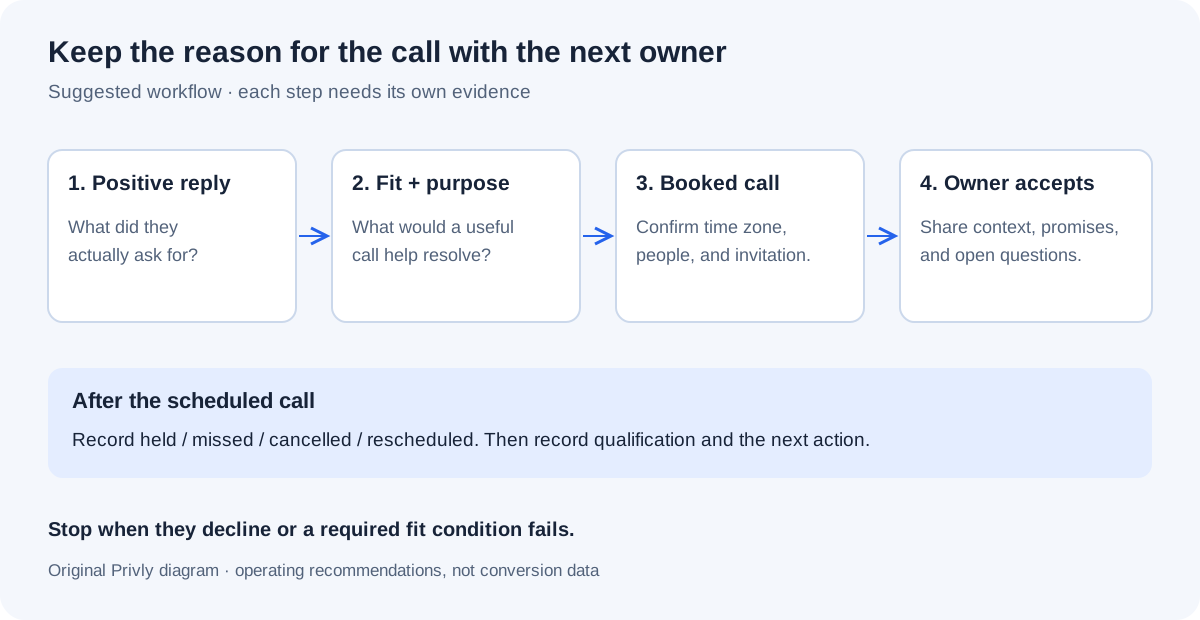
The person taking the call needs to know why it exists. Give one owner the thread context, the agreed purpose, and the open questions. Ask that person to accept the handoff. Until they do, the outreach owner remains responsible for the next action.
| Field | What to record |
|---|---|
| Person and company | Confirmed name, current role, account, and conversation link. |
| Reason for interest | The buyer’s actual words, with the date; distinguish them from your interpretation. |
| Fit and constraints | Relevant use case, required systems, exclusions, and facts still unknown. |
| Agreed meeting | Purpose, date, time zone, duration, invitation, and expected participants. |
| Commitments | What you promised to send or demonstrate before or during the call. |
| Owner acceptance | Named person taking the call and when they accepted responsibility. |
| After the call | Held, missed, cancelled, or rescheduled; qualification findings; next action and owner. |
Keep this internal summary separate from the invitation the buyer sees. Share only the information the next owner needs, within the right client or team context. For an agency, agree the client’s qualification and handoff rules before outreach begins so an accepted meeting does not become a dispute about what was promised.
Measure the step that is actually losing conversations
Use one cohort of unique people and a fixed review window. Count a positive reply only after reviewing its meaning. Track meeting records separately, linking reschedules to the original conversation so one person does not inflate the funnel.
The following fictional cohort contains 100 people who received an initial LinkedIn message in September. Replies and bookings are observed for 30 days after each person’s initial message. Attendance is assessed after every booked call in the cohort has reached its scheduled date. Each person has at most one initial call in this example.
| Measure | Fictional count | Calculation |
|---|---|---|
| People messaged | 100 | Cohort denominator |
| People who replied | 20 | 20 / 100 = 20% recipient reply rate |
| People with a positive reply | 10 | 10 / 100 = 10% positive reply rate |
| People with a booked call | 6 | 6 / 10 = 60% positive-reply-to-booking rate |
| People whose call was held | 4 | 4 / 6 = 66.7% booked-to-held rate |
| People with a qualified call held | 3 | 3 / 100 = 3% messaged-to-qualified-call rate |
These values explain the arithmetic; they are not a target or industry benchmark. The two booked calls that did not happen could be cancellations or no-shows, so inspect their status before diagnosing attendance. Calls whose scheduled dates are still ahead belong in a pending category and should not be treated as failed attendance.
Many replies but few relevant conversations suggest a targeting or offer problem. Relevant interest without bookings calls for a review of the meeting purpose, next question, and scheduling exchange. Bookings without attendance call for a review of invitation clarity and timing. Held calls that fail qualification point back to fit criteria and the handoff.
Review the underlying threads before changing the campaign. For the next comparable cohort, change one part of the process and keep the audience, sender, offer, and observation window as consistent as possible. Small batches can suggest questions to investigate; they do not establish that a particular message caused an improvement.
Mistakes that make a positive reply harder to convert
- Treating a resource request as agreement to a product demonstration.
- Asking the buyer to repeat information already present in the LinkedIn conversation.
- Hiding a direct question about price or compatibility behind a meeting request.
- Sending several competing links or asking for a time without a time zone.
- Handing the call to someone who has neither the context nor responsibility for it.
- Reporting bookings as qualified opportunities before the qualification work has happened.
Questions about booking sales calls on LinkedIn
When should I ask for a call?
When a conversation about their situation would help answer something they care about, and there is a plausible fit with your offer. An explicit demo request can go straight to scheduling after checking the use case. Someone requesting a resource should receive it before being asked for more of their time.
Should I send a calendar link in the first message?
For a new cold approach, first establish why the conversation is relevant. Once the person wants to meet, a booking link can be convenient. Offer a clear meeting purpose and use the correct owner’s page. If they prefer to choose between two times in the thread, arrange it there.
Do I need to confirm budget before every first call?
Set the minimum criteria for your offer. A first discovery call may reasonably establish budget and approval requirements. If price is a known constraint or the buyer asks, discuss it before scheduling. Record an unanswered budget question as unknown rather than calling the lead fully qualified.
What is a good LinkedIn meeting-booking rate?
Start by naming the denominator: people messaged, people with positive replies, or held calls. Compare cohorts with similar audiences, senders, offers, and review windows. No reliable primary evidence reviewed for this guide establishes a universal LinkedIn positive-reply-to-qualified-call rate.
Can AI manage the next reply?
It can help summarize the thread and draft an answer using supplied facts. Review whether it has mistaken curiosity for buying interest, invented availability, or promised an unsupported feature. The person responsible for the conversation should approve the actual next step.
Give the next interested prospect one clear next step
Take one positive reply, write down what the person wants, and decide what a call would resolve. Answer their immediate question, propose the relevant next step, and keep the context with the person who will take the meeting.
If prospect fit is still unclear, start with the free ICP identifier in Privly to make the audience and offer more specific before preparing another outreach campaign.
Research reviewed October 20, 2026: Gong’s email CTA analysis, Salesforce’s qualification guidance, and Calendly’s reminder automation documentation. Messages, meeting definitions, the handoff worksheet, diagram, and cohort calculations are original examples and recommendations.
 LinkedIn Messages
LinkedIn Connection Request Messages: What to Write and When
Write a clear LinkedIn connection request message with six original note examples, a decision table, current platform guidance, and a pre-send checklist.
October 13, 2026 · Giress Kenn LinkedIn Messages
LinkedIn Cold Outreach Messages: Personalized Templates and Examples
Write a relevant LinkedIn cold outreach message with six original templates, a prospect-evidence worksheet, and a practical personalization checklist.
October 9, 2026 · Giress Kenn LinkedIn Outreach
How to Set Up a B2B LinkedIn Outbound Campaign
Set up a B2B LinkedIn outbound campaign with an audience worksheet, prospect review, message sequence, launch checklist, and clearly defined pilot results.
October 9, 2026 · Zyaam Ali