OpenClaw by Privly: AI Marketing Platform for 2026
This article covers Privly's legacy Social Publishing capability, which remains available only to workspaces with legacy access and is not the primary current product.

You are paying for 5 marketing tools when you only need one
Most marketing teams in 2026 still juggle separate tools for SEO research, content ideation, caption writing, social scheduling, and analytics. That is 5 subscriptions, 5 logins, and 5 places where your data gets siloed.
The result: fragmented workflows, wasted time switching between tabs, and strategies that never feel connected.
What if one platform handled all of it — from the moment you ask "what should I post about?" to the moment your content goes live across every channel?
That is exactly what OpenClaw does. Built by Privly, OpenClaw is a full-stack AI marketing engine that claws through the noise and gets your content in front of the right audience. Today, we are pulling back the curtain on how it works — and giving you a first look at features coming soon.
Coming soon: the AI Brand Brain — your always-on marketing strategist
We are building something that goes beyond content creation. The AI Brand Brain is a workspace intelligence layer that will live inside your Privly dashboard — purpose-built for strategy, planning, and analysis.
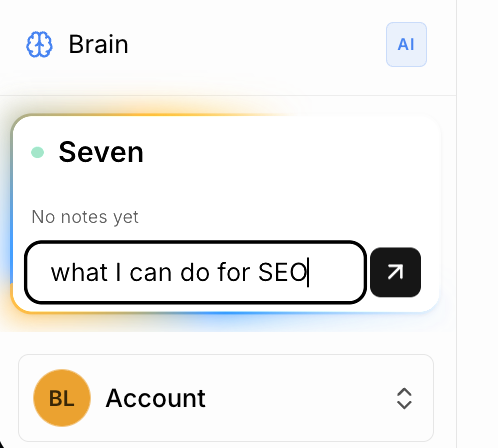
Here is an early look at what happens when you ask the Brand Brain a simple question like "what can I do for SEO":
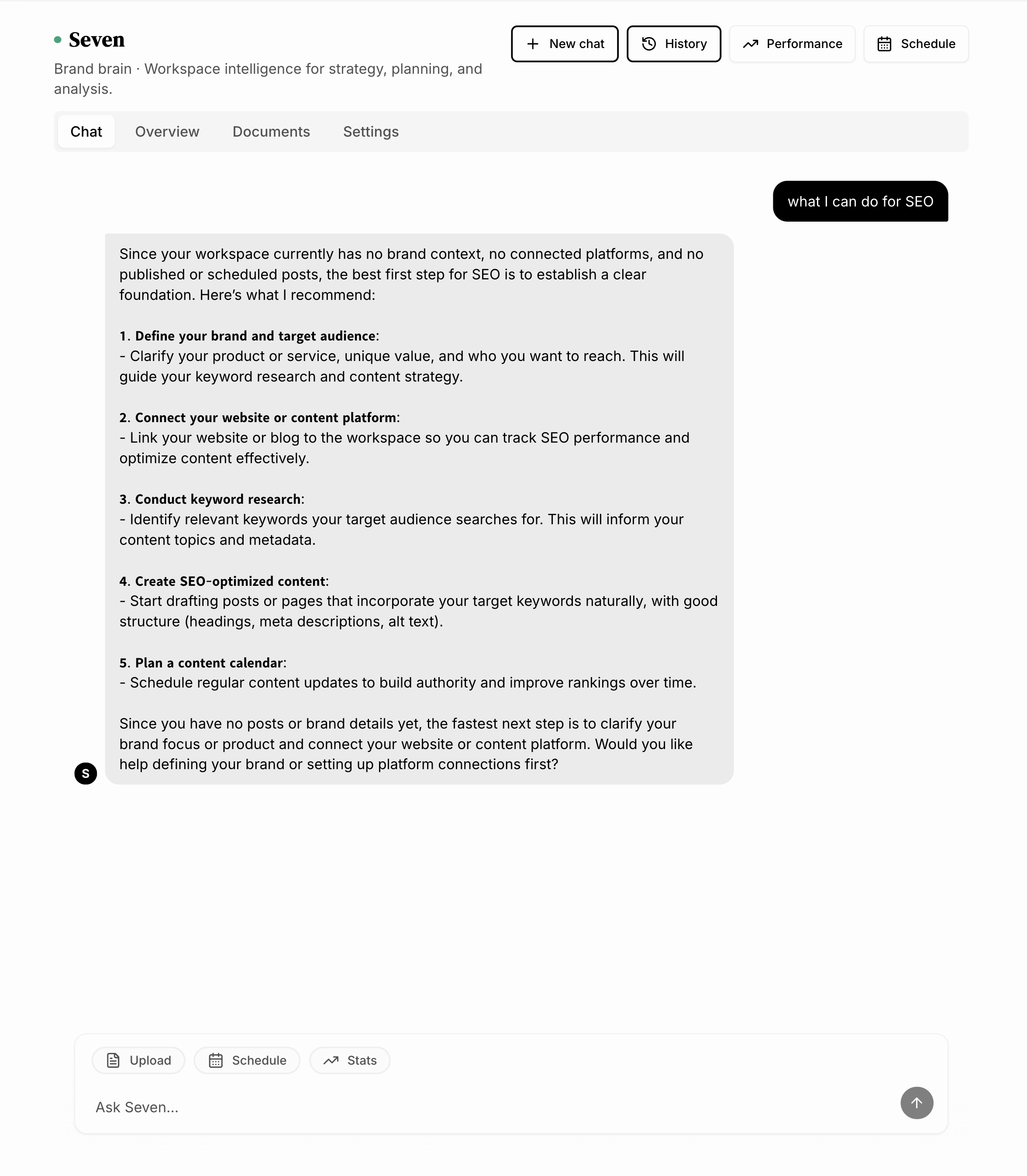
The Brand Brain analyzes your current workspace — your brand context, connected platforms, published content, and performance data — then delivers a tailored action plan:
- Define your brand and target audience — clarify your product, unique value, and who you want to reach
- Connect your website or content platform — link your blog so the AI can track SEO performance
- Conduct keyword research — identify the exact terms your audience searches for
- Create SEO-optimized content — draft posts with proper headings, meta descriptions, and alt text
- Plan a content calendar — schedule regular updates to build authority over time
This is not a one-size-fits-all template. The Brand Brain will adapt its recommendations based on what you have already done and what gaps remain. The more you use it, the smarter it gets about your brand. Stay tuned — this feature is launching soon.
What OpenClaw replaces in a typical marketing stack
Most lean teams do not have a marketing problem. They have a workflow fragmentation problem.
A normal week often looks like this:
| Job to be done | Common tool today | What breaks |
|---|---|---|
| Find content ideas | SEO tool, spreadsheet, notes app | Ideas are not tied to publishing capacity |
| Write post drafts | ChatGPT, docs, social apps | Brand voice changes from draft to draft |
| Adapt for channels | Manual copy editing | The same idea gets rewritten 5 times |
| Schedule content | Separate scheduler | Calendar does not know why the post exists |
| Review performance | Analytics dashboard | Results do not feed back into new ideas |
OpenClaw pulls those steps into one operating loop. The goal is not to replace strategic thinking. The goal is to remove the busywork between strategy and execution.
That matters because small teams cannot afford handoffs that only make sense in large departments. If the same person is choosing the angle, writing the copy, and publishing the post, the tool should support that whole motion instead of splitting it across separate subscriptions.
The OpenClaw workflow: strategy, creation, publishing, and learning
A useful AI marketing platform should help with more than first drafts. It should make the entire content cycle easier to run.
OpenClaw is designed around four connected layers:
1. Strategy layer
This is where the Brand Brain will help turn vague goals into action plans. Instead of asking "what should we post?", you can ask more useful questions:
- Which topics should we write about next?
- Which channels are underused?
- Which content gaps are hurting our SEO?
- Which posts should be repurposed into social campaigns?
The difference is context. A generic chatbot gives generic advice. A workspace-aware assistant can look at your actual content, platforms, and performance history before recommending the next move.
2. Creation layer
This is where OpenClaw helps you get from idea to draft. You can start from a product, audience, campaign, or blank prompt. Then the AI turns that context into hooks, captions, hashtags, and platform-specific variants.
The practical win is speed. You do not need to write one LinkedIn post, then manually shrink it for X, then rewrite it again for Reddit, then change the tone for Instagram. OpenClaw helps you create the first version and adapt it without leaving the editor.
3. Publishing layer
Creation is only useful if the content actually ships. OpenClaw keeps scheduling inside the same workspace so the campaign does not die in a draft folder.
You can plan the week, attach media, choose platforms, and schedule posts from one flow. That is especially useful when your team is already trying to schedule LinkedIn posts automatically, post to X, keep Instagram active, and maintain a blog at the same time.
4. Learning layer
The final layer is feedback. Once posts go live, the platform should help you understand what worked and what should change next.
That means tracking more than vanity metrics. A useful marketing engine should help answer:
- Which topics earn qualified replies?
- Which platforms are worth more effort?
- Which hooks keep appearing in top posts?
- Which content can be turned into another format?
This is how a content workflow improves over time. You do not just publish more. You publish with a clearer memory of what already worked.
Available now: from "I'm stuck" to published post in 4 steps
Every marketer knows the feeling: you need to post something today, but you have zero ideas. OpenClaw's AI Assistant has a workflow designed exactly for this moment — the "I'm stuck" flow.
Here is how it works:
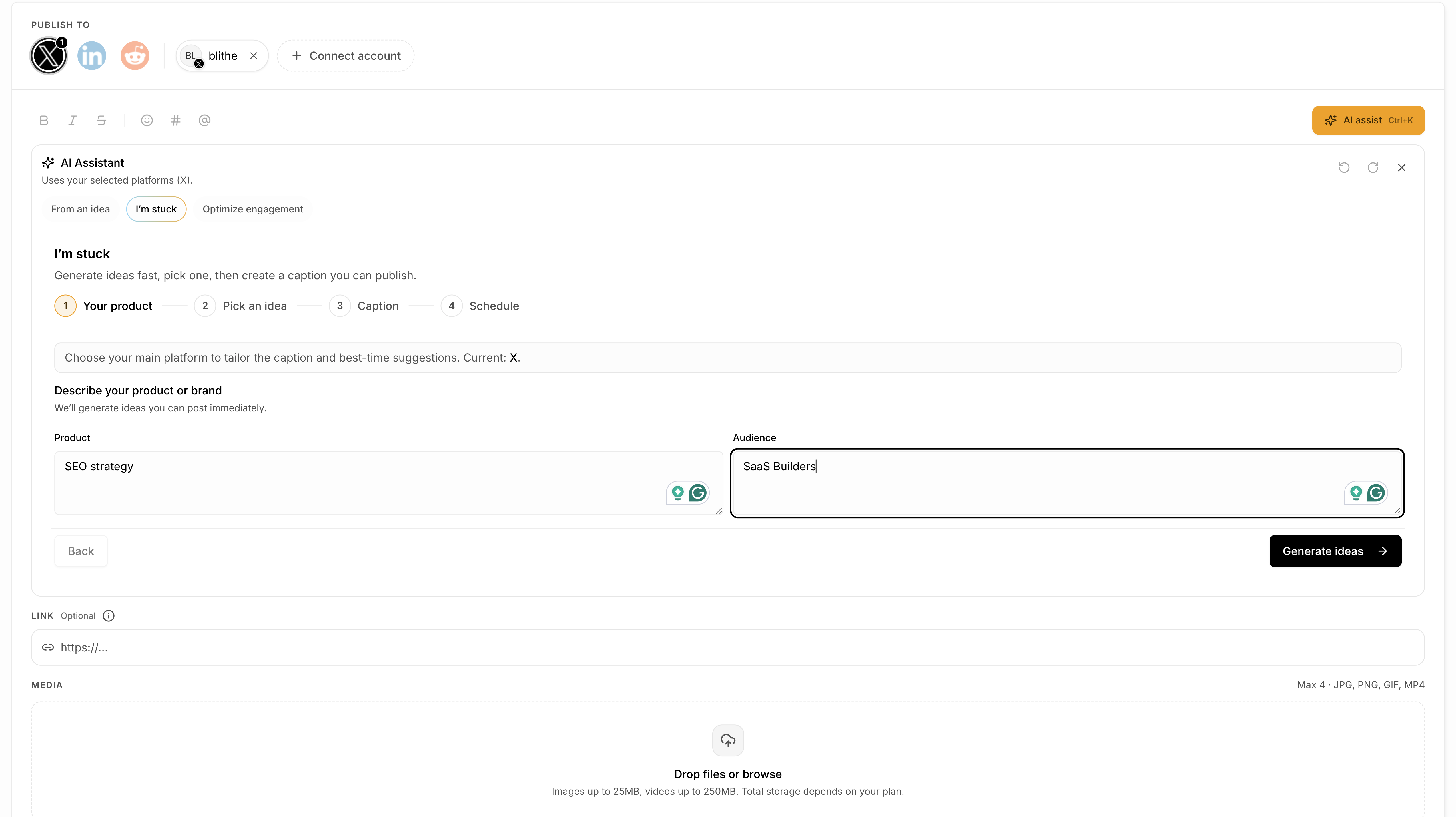
Step 1: Describe your product and audience
Tell the AI what you are marketing and who you are targeting. For example: Product = "SEO strategy", Audience = "SaaS Builders." You also choose your target platform — X, LinkedIn, Reddit, or all of them.
Step 2: Pick an idea
The AI instantly generates a dozen content ideas tailored to your product and audience. For an SEO strategy product targeting SaaS builders, you might see suggestions like:
- Explain how to optimize SaaS landing pages for long-tail keywords
- Share a checklist for on-page SEO specific to SaaS platforms
- Show how schema markup boosts SaaS product visibility
- Tell how a small SaaS startup grew organic traffic 3x in 6 months
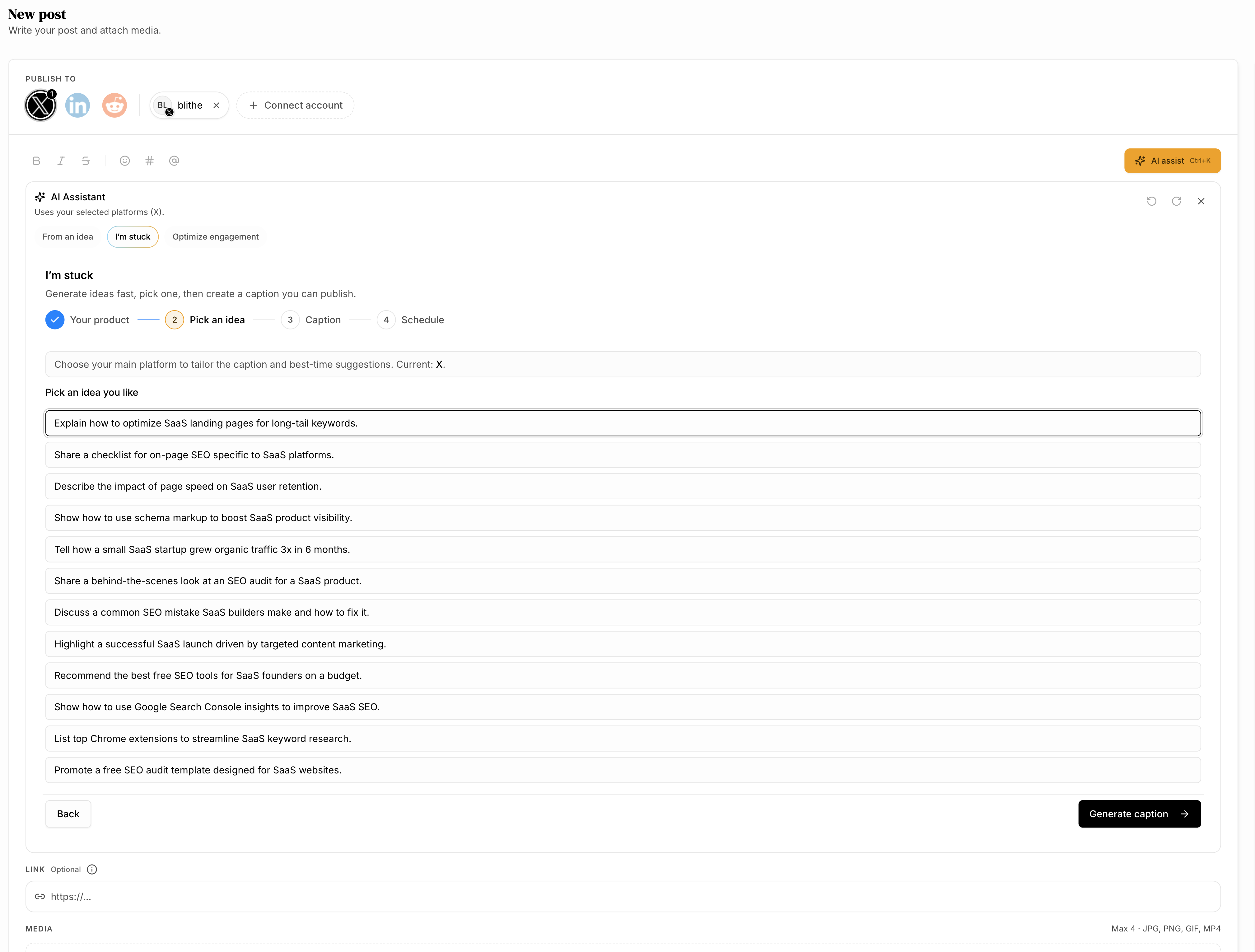
Pick the one that resonates. No more staring at a blank screen.
Step 3: Generate and refine your caption
Once you pick an idea, the AI drafts a full caption optimized for your selected platform. But here is where it gets interesting — you are not stuck with the first draft.
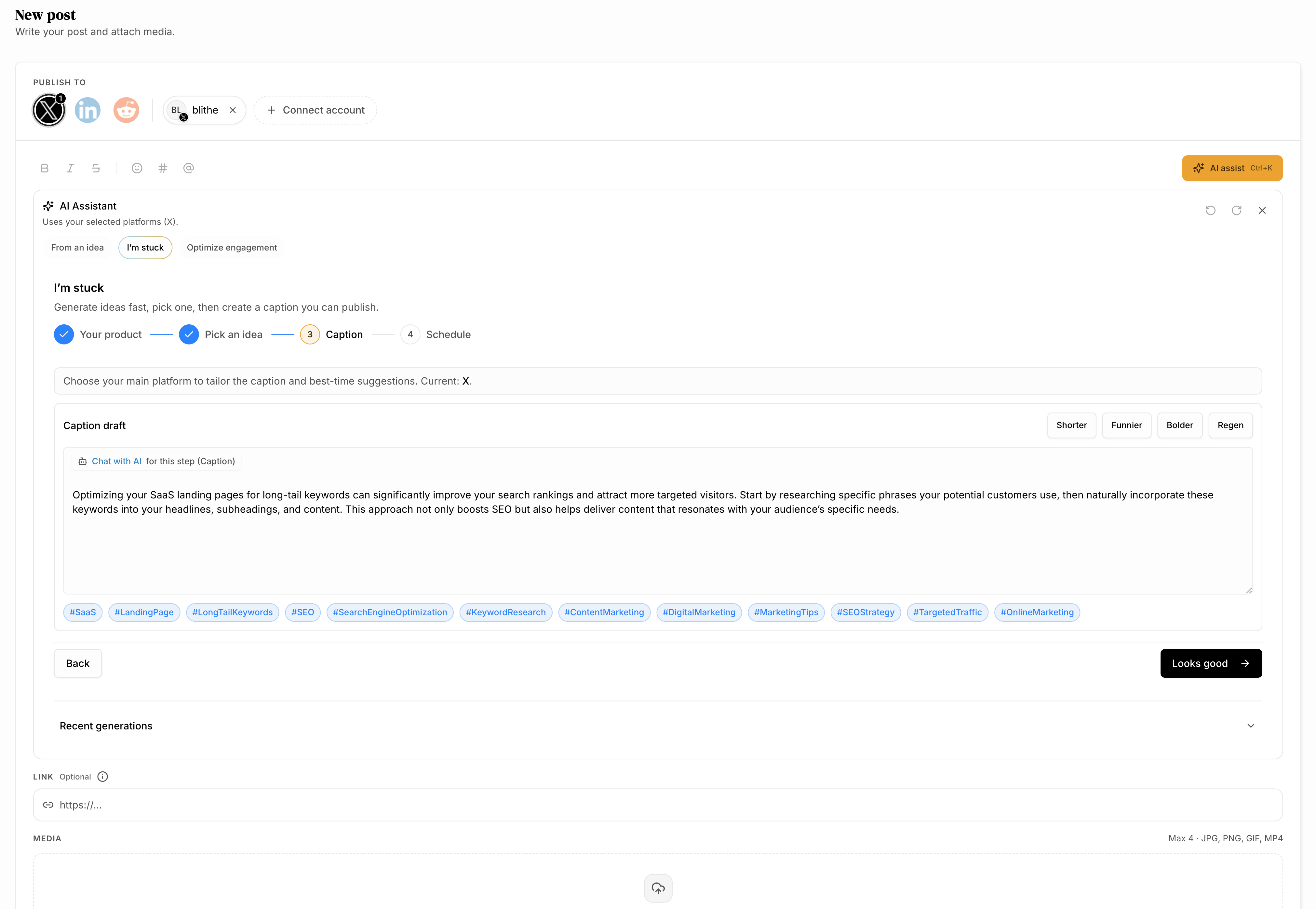
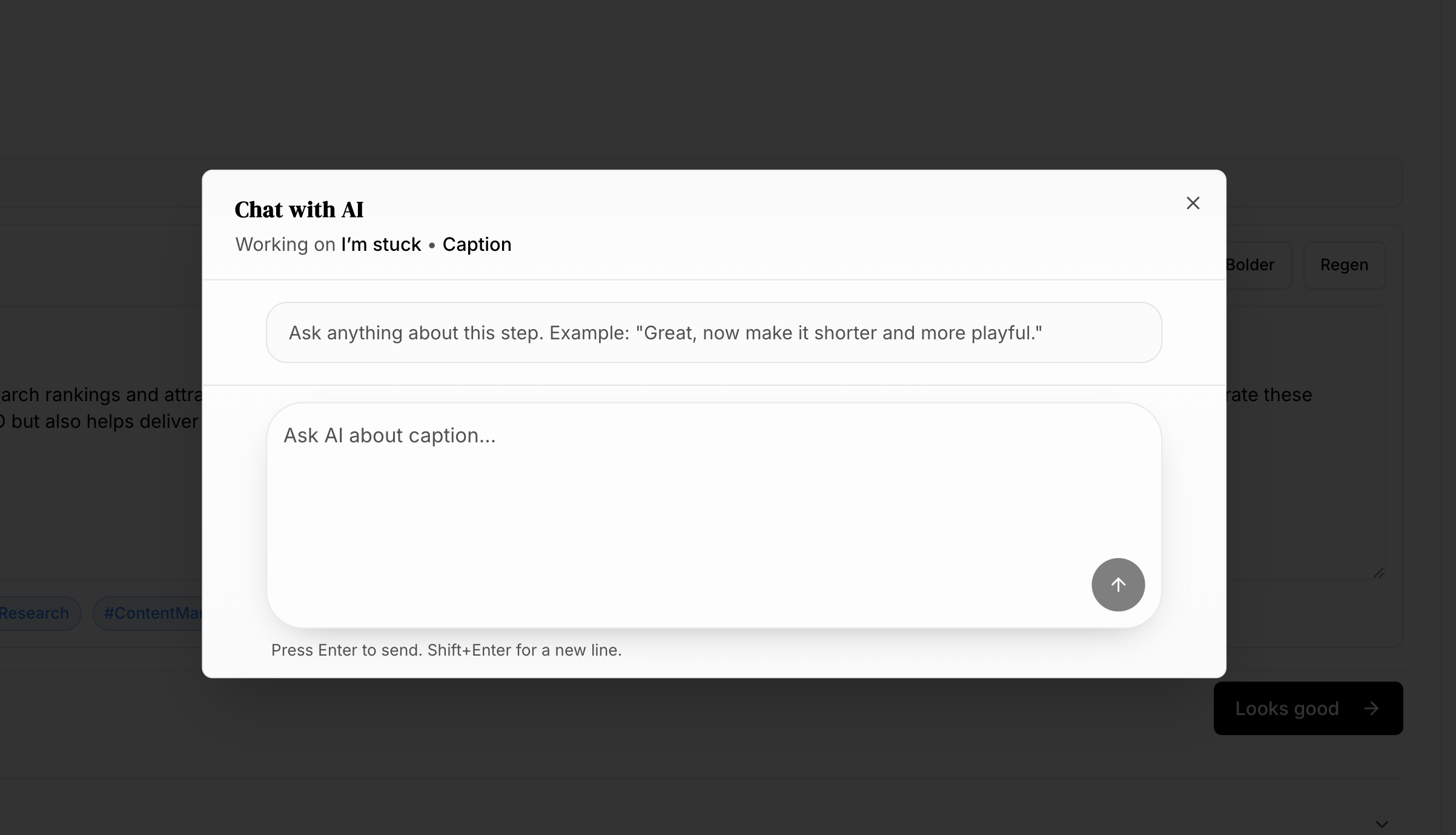
You get one-click refinement buttons: Shorter, Funnier, Bolder, or Regen. And if you want something more specific, the Chat with AI feature lets you have a conversation about the caption — "make it shorter and more playful," "add a statistic," "change the CTA."
The AI also auto-generates relevant hashtags: #SaaS, #LandingPage, #LongTailKeywords, #SEO, #ContentMarketing, and more.
Step 4: Schedule and publish
Attach media, add a link, pick your best time, and schedule. Done. What used to take 45 minutes of context-switching between tools now takes under 5 minutes — without leaving your OpenClaw workspace.
Real use cases for small teams
OpenClaw is most useful when your team has more marketing surface area than headcount. That is common for SaaS founders, creators, agencies, and service businesses trying to stay visible without hiring a full content department.
Here are a few practical examples.
SaaS founder launching a new feature
A founder can describe the feature, audience, and launch goal. OpenClaw can help turn that into:
- A LinkedIn launch post
- A shorter X thread
- A customer pain-point post
- A follow-up educational post
- A CTA-driven announcement
Instead of creating each asset from scratch, the founder starts with one campaign idea and turns it into a week of channel-native posts.
Small agency managing several client calendars
An agency can use OpenClaw to standardize repeatable work without making every client sound the same.
The team can keep each brand's context separate, generate draft options, refine tone, and schedule content in batches. That reduces the slowest part of agency delivery: moving from approved strategy to publish-ready posts.
Creator building authority across platforms
A creator can turn one original idea into multiple formats. A strong LinkedIn post can become a Threads prompt, an X post, an Instagram caption, and a short video outline.
The key is not copy-paste. The key is adaptation. OpenClaw helps preserve the core idea while changing length, tone, and format for each channel.
Lean marketing team running SEO and social together
SEO and social should not live in separate calendars. A blog topic can become a week of social posts, and a high-performing social idea can become a blog outline.
If your team already uses a social media content calendar template, OpenClaw gives that calendar an execution layer. The plan becomes drafts, posts, and scheduled content instead of another document to maintain.
Why "full-stack" matters more than "best at one thing"
The marketing tool landscape in 2026 is crowded. There are great tools for scheduling posts, decent tools for AI caption generation, and solid tools for SEO research. But none of them talk to each other.
Here is what breaks when your tools are disconnected:
| Problem | What happens | Business impact |
|---|---|---|
| Data silos | Your SEO tool does not know what your social scheduler is posting | You miss opportunities to repurpose high-performing content |
| Context switching | 5 tabs, 5 logins, 5 different UIs | 2+ hours/day wasted on tool management instead of strategy |
| Inconsistent brand voice | Each tool generates content independently | Your audience gets mixed messages across channels |
| No feedback loop | Analytics live in one tool, content creation in another | You keep creating content that does not perform, with no signal to course-correct |
A full-stack platform eliminates all of this. OpenClaw's AI knows your SEO data, your content performance, your brand voice, and your publishing history. Every recommendation is informed by everything else. That is the compound advantage — and with the Brand Brain coming soon, the intelligence layer gets even deeper.
How to decide whether you need a full-stack AI marketing platform
OpenClaw is not for every team. If you only post once a month on one channel, a simple scheduler is enough. The value appears when content work becomes repeatable and cross-platform.
Use this decision table:
| Situation | Simple tool is enough | OpenClaw makes more sense |
|---|---|---|
| Number of channels | 1 to 2 | 3 or more |
| Content volume | Occasional posts | Weekly or daily publishing |
| Drafting process | You already have finished copy | You need idea and caption help |
| Team workflow | One person, no review | Founder, VA, agency, or small team |
| Strategy needs | No SEO or campaign planning | You want connected ideas, posts, and performance |
The moment your content calendar requires multiple channels, multiple formats, and repeated weekly production, a standalone scheduler starts to feel incomplete. You do not just need a place to queue posts. You need a system that helps decide what to publish, creates the draft, adapts it, and keeps the workflow moving.
Common mistakes when adopting AI marketing tools
Using AI as a replacement instead of an accelerator — AI generates the first draft; you add the human insight, personality, and nuance that builds trust
Not connecting your platforms — an AI that does not know your brand context gives generic advice. Connect your accounts first
Ignoring the data loop — the best AI marketing is iterative. Publish, measure, learn, adjust. Privly's Performance and Stats features exist for this reason
Over-automating without review — schedule posts, but review them. Your audience can tell when nobody human looked at the content
Keeping strategy outside the workflow — a strategy doc is useful, but only if it changes what gets published. Bring goals, audiences, and campaign context into the tool where content is made.
Measuring everything as equal — not every post has the same job. Some posts build trust, some drive traffic, some test messaging, and some ask for action. Judge them by the job they were meant to do.
Letting AI flatten your voice — use AI to get to a draft faster, then add your own specificity: customer language, product details, opinions, examples, and proof.
The ROI: before vs. after OpenClaw
| Metric | Before (fragmented tools) | After (OpenClaw by Privly) |
|---|---|---|
| Time to create + publish 1 post | 45–60 minutes | 5–10 minutes |
| Monthly tool costs | $200–$500 (multiple subscriptions) | $29 (one platform) |
| Content ideas generated per session | 1–2 (manual brainstorm) | 10–12 (AI-generated) |
| Platforms managed from one dashboard | 1–2 | All major platforms |
| Strategy-to-execution gap | Days to weeks | Minutes |
Frequently asked questions about OpenClaw
Is OpenClaw just another AI caption generator?
No. A caption generator solves one narrow part of the workflow. OpenClaw is built to connect planning, drafting, scheduling, and performance. Captions matter, but the bigger problem is getting the whole system to run every week.
Does OpenClaw replace a marketing strategist?
No. It helps a strategist move faster. You still decide positioning, audience, offers, and priorities. OpenClaw makes those decisions easier to turn into publish-ready content.
Can small teams use it without a content department?
Yes. That is the point. Small teams often need the output of a content department without the headcount. OpenClaw gives them a repeatable workflow for ideas, drafts, scheduling, and review.
What makes it different from using ChatGPT plus a scheduler?
ChatGPT is powerful, but it does not naturally know your publishing calendar, platform mix, or performance loop. A separate scheduler does not know why a post exists. OpenClaw connects those pieces so the content workflow has continuity.
Stop juggling tools — start building a marketing engine
If you are still stitching together 5 different tools to run your marketing, you are not saving money — you are wasting time that could go toward strategy and growth.
OpenClaw brings AI content creation, multi-platform scheduling, and performance analytics into one workspace — with an AI Brand Brain on the way that will add SEO intelligence and strategic planning to the mix. One login. One platform. Zero excuses.
Ready to replace your marketing tool stack with one AI-powered platform? Start your free trial at Privly and experience OpenClaw in your first 10 minutes.
More from the blog
Competitor Monitoring: How to Find Buyers Ready to Switch
Monitor competitor mentions for dissatisfaction, alternative searches, comparison questions, missing capabilities, and genuine buying opportunities.
August 13, 2026 · Privly Team
Intent-Based Outreach: Turn Buying Signals Into Relevant Messages
Learn how buyer signals, source evidence, fit, timing, channel choice, and human review create more relevant B2B outreach.
August 13, 2026 · Privly Team
Social Listening for Lead Generation: How to Find Buying Signals
Use social listening to find buying signals, separate real opportunities from ordinary mentions, and qualify people before deciding whether to act.
August 13, 2026 · Privly Team